Three layers that never merge.
When we speak of inner phenomena we often mix three languages that make different claims to truth. This site separates them cleanly. Choose one, read how it speaks.


chazon.eu/elements showed the outer cosmos — 118 elements from hydrogen to the Merkaba. Here we map the inner cosmos: the same structure, but in experience. You walk at your own pace — no test, no required path.
Every phase of elements has its counterpart in energies. Mendeleev's periodic table is mirrored in Clare Graves' values-system spiral. The periodic table by weight — the spiral by complexity. Whoever has seen both has entered the same space from two directions.
 Source
 Fire
Fire
 Water
Water
 Air
Air
 Earth
Earth
Geometry · Phenomenology · Myth — three planes that never merge, but survey the same territory from three directions. What is measurable, we say. What is felt, we describe. What tradition claims, we mark. Drag the wheel. Choose a layer.
When we speak of inner phenomena we often mix three languages that make different claims to truth. This site separates them cleanly. Choose one, read how it speaks.
The natural-science layer. What shows up in brain scanners, EEG, heart-rate variability, controlled studies. Predictive Coding, Default Mode Network, quantum biology. Here the rule is: hypothesis, method, replication. We claim only what we can substantiate.
The experience layer. How grief feels in the chest, where anger sits in the body, what changes after meditation. First-person data. Husserl, Merleau-Ponty, contemplative traditions. Here the rule is: precise description of the immediately given. Subjective, but not arbitrary.
The cultural meaning layer. How 5,000 years of wisdom traditions have drawn the same territory — chakras, Wu Xing, Sephiroth, archetypes. Image and symbol, not proof. Here the rule is: cite with humility, never sell as explanation. Myth is condensation, not mechanism.
Phases I to IV trace the inner scaffolding: where am I on the spiral, who narrates world to me, which five elemental feelings rise, which three filters sieve. The values-scaffold, before we feel it. Begin without haste.
Mendeleev ordered atoms by weight and found a pattern. Clare Graves ordered values by complexity and found eight.
Do you know the moment when you first understood that the other is not simply wrong — but is seeing rightly from another stage? Exactly there the spiral begins.
Spiral Dynamics began as a longitudinal study (Clare Graves, 1960s · 1,000+ adults over 20 years). Beck & Cowan systematised it in 1996. Longitudinal data show reproducible stages, not types.
Precursors in Jean Gebser's Ever-Present Origin, in the Vedic Yugas, in Hegel's dialectic of stages. The idea that consciousness unfolds in stages is 5,000 years old.
Ken Wilber's AQAL integrates Spiral Dynamics with Kohlberg's stages of moral development and Loevinger's ego development. Imaging correlates of stage transitions remain rare — the model is closer to lived experience and industry use than to laboratory validation.
vMeme (kurz für Value Meme) ist Clare Graves' Begriff für eine Wertesystem-Stufe. Jedes vMeme ist eine kohärente Logik, mit der ein Mensch — oder eine Kultur — die Welt sortiert: was wichtig ist, was gefährlich, was wahr.
Die acht klassischen Stufen tragen Farb-Codes (Beige · Lila · Rot · Blau · Orange · Grün · Gelb · Türkis). Sie sind kein Charakter-Typ, sondern eine bevorzugte Lage — du wechselst situativ zwischen 1–2 Nachbarstufen.
Wichtig: höher heißt nicht besser, sondern komplexer angepasst an Lebensbedingungen. Jedes vMeme bleibt aktiv und wird in den darüberliegenden integriert (Wilber: transcend and include).
DNA is the outer helix of your form. The Default Mode Network is the inner helix of your self.
Do you know the moment when you wanted to take a pause — and your head immediately started telling stories? The pause itself was the door. What speaks behind the door has a name: Default Mode Network.

Raichle & Snyder identified the DMN in 2001 via PET studies. Today's gold standard: fMRI resting-state connectivity. Active during: daydreaming, autobiographical thinking, mind-wandering. Inactive during: focused external tasks. Luppi, Lyu & Stamatakis (2025, Current Opinion in Behavioral Sciences) argue the DMN is the core of consciousness itself, evolutionarily stable across mammalian species.
Buddhist texts describe "papañca" — the world-building activity of mind, stilled by Vipassanā. Christian mysticism: vacare Deo · the fertile emptiness. Sufism: fanā · the dissolution of the self-narrating mind.
Brewer et al. (2011, replicated 2024): experienced meditators show reduced DMN activity. Psilocybin (Carhart-Harris 2014, 2023): temporary DMN deconstruction correlates with ego dissolution. Tradition has been given a neural address.
Mirror to Elements · Living Matter DNA helix · 4 bases, one structure · outer double helix, inner hub-and-spokeWhen you do nothing, the machine you yourself are runs at full throttle.Raichle 2001 · Buckner 2008 · Luppi 2025 Update
The earth-element from within, played through: fire-feeling, water-feeling, air-feeling, earth-feeling, source-feeling. Not personalities — states you wander through daily.
Do you know the moment when you woke in the morning and thought: something is burning today? Or: today I just want to flow? That is not mood. That is mode.
Outward push, impatience, initiative. The hour in which you write the mail you have been postponing for weeks.
Flow, surrender, longing. The moment you listen to someone and realise you do not have to prepare an answer.
Clarity, distance, language. The middle of the walk, when the thought suddenly finds its sentence.
Grounded, persistent, present. The feeling after a hard hour of garden work or three sets of squats.
Nothing missing. Rarely long, but unmistakable. Sometimes in a summer forest, sometimes in the middle of the subway.
Not "are you a water type" — but "which water is up now". A mode map, not a personality test.
Plutchik's Wheel (1980, currently extended) operationalises base emotions. HRV studies (HeartMath 2025) show distinct autonomic signatures for activating vs receiving states — measurable in milliseconds.
The five elements come from Indian (Bhûtas), Chinese (Wu Xing · slightly different), Greek (Empedocles), Tibetan, and Hebrew (Shalem) traditions. Four outer elements, one inner element. Universal architecture.
Not a personality test — a state map. You are not one element. You are all five, in different mixtures each hour. Self-observation becomes a weather map of the inner.
In 2014 Nummenmaa, at Aalto University, measured where people feel emotions in the body. Seven hundred and one participants, Finnish and Taiwanese — and the maps were cross-culturally universal. Choose a feeling and see where it lives.
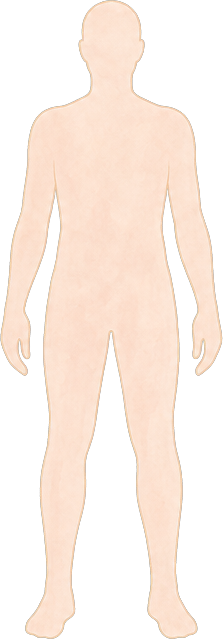
Phase III showed five element-feelings of the Shalem tradition. Chinese medicine maps the same five somewhat differently: not as feelings, but as phases of transformation — Wood, Fire, Earth, Metal, Water. Each with a season, an organ-circle, and two fixed relations to its neighbours. Two maps of the same territory.
Choose a phase. In the detail you see whom it nourishes (生 Sheng) and whom it tames (克 Ke) — both relations are clickable, you can wander through the whole cycle.
Sixty percent of the periodic table sits inside your smartphone. Inside you sit three devices that generate your reality anew every day.
Do you know the moment when someone tells you something — and you do not hear it, because your head is on something else? You received the sound. You did not receive the world. Between sound and world sit devices.
Your brain guesses the world before it arrives — and corrects only on mismatch. Most perception is prediction, not reception. Friston (2010) formalised it as the Free-Energy Principle.
→ Karl Friston · UCL · 2010–2025Classical estimate (Zimmermann 1989, popularised by Nørretranders): your sensory system takes in roughly 11 million bits/s, of which only about 50 bits/s become conscious. The numbers are order-of-magnitude comparisons, not measurements — but the asymmetry is real. Selection is made by a network of salience region (right insula), DLPFC and attentional networks. You see what you seek.
→ Cohen, Posner · Attention Network Test · 2002–2024On top of perception and attention sits a third: your story about yourself. "That's who I am" — and that filters again. Bruner (1991): narrative self. McAdams (2013): life-script as identity.
→ Bruner, McAdams · narrative psychology · 1991–2023Predictive-coding models are now standard in computational neuroscience. EEG studies show Mismatch Negativity (MMN) as a neural signal for prediction errors. Replicable in infants from 4 months.
Buddhism: "The world is mind-made" (Dhammapada Verse 1). Kant: forms of intuition, categories — we do not see the world but our filters. Indian Māyā doctrine: veil before the direct.
What tradition described as "veil" can today be modelled as filter architecture. Meditation = filter-awareness. Psychedelics = temporary filter loosening. The devices become object instead of apparatus.
Most perception is prediction, not reception.Karl Friston · Free-Energy-Principle
Sphere A asked: where am I on the spiral. Sphere B asks: how do I feel that. From the concept of values to bodily experience — five phases, continuous.
It has 40,000 neurons of its own, sends more signals to the brain than the other way round, and generates the strongest electromagnetic field in your body. When you practice, it breathes with you in coherence.
Do you know the moment when your breath deepens by itself? You did not have to do anything. Your heart delivered the rhythm and the rest of your body followed. That is HRV coherence — and you can practice it.
Coherence breathing slows your heart rhythm to about 5.5 breaths per minute. Studies show: after 3-5 minutes the HRV shifts measurably toward coherence (McCraty et al. 2024). Try it — the orb follows the rhythm.
HRV studies 2024 show reproducible effects of coherence breathing: 5-10% HRV increase after 4 weeks of daily practice, cortisol reduction (Lehrer 2020 meta-analysis, n=2,687).
Prāṇāyāma has described exactly this breath-slowing for 2,500 years. In Christian mysticism: the prayer of the heart. In Sufi tradition: zikr. A universal practice, now validated with instruments.
The heart's electromagnetic field is measurable with high-sensitivity SQUID magnetometers a few centimetres above the skin — the popular claim of "up to 1 m" comes from HeartMath publications and is not peer-review-confirmed outside that source. Whether the field carries information remains open. The effect of coherent breathing on HRV and vagal tone is well documented independently of the field-debate.
When did you last notice your breath settling on its own? What was the trigger?
Mirror to Elements · Earth Explorer Magnetic fields · Earth's iron core · outside planetary field, inside heart fieldYour heart sends more signals to the brain than the other way around.McCraty · HeartMath Institute · 2024
In your premotor cortex, neurons fire not only when you act — but also when you see someone else act. You live their inside inside your own.
Do you know the moment when you walk into a room and immediately know: there is tension here? No one has said anything. But your body has already read the field of the others. That is co-regulation in real time.
Rizzolatti et al. 1996 discovered mirror neurons in macaques. In humans: fMRI activation in Broca's area and the inferior parietal cortex during mere observation of goal-directed movements.
Buber: I become through Thou. Levinas: the face of the Other as ethical origin. Buddhism: the five aggregates (skandhas) form in resonance. We have never lived this alone.
Polyvagal theory (Porges 2011) names co-regulation as the neural platform of attachment. Several parent-infant HRV-synchronisation studies (among them Feldman et al.) show correlations of r≈0.5 at eye contact — the hearts truly synchronise. Polyvagal theory itself is clinically effective, but theoretically contested (Grossman 2023).
Through what do two people synchronise most strongly in the body?
Peterson & Seligman analysed every major value tradition — from Aristotle to Confucius, from Buddhism to the Bible. Everywhere the same six families appear.
Do you know the feeling of using a strength so natural it does not feel like effort? VIA studies say: every person has 3-5 such signature strengths. They are your home mode.
VIA Inventory (Peterson & Seligman 2004) with 24 character strengths in 6 families — n>1 million subjects worldwide. Factor analysis confirms the 6-family model across cultures (Park & Peterson 2024 update).
Aristotelian cardinal virtues (prudence, courage, temperance, justice) + Christian faith/hope/love + Buddhist Brahmaviharas (loving-kindness, compassion, sympathetic joy, equanimity) — all compatible.
Positive psychology brought the idea of virtue out of philosophy and made it measurable — and found: deployment of strengths correlates with wellbeing more strongly than life circumstances (Niemiec 2024, effect size d=0.84).
Which two virtues feel like your natural home? In what hour this week did you last live them?
They are a path you walk — sometimes forward, sometimes backward, often simultaneously across different domains of life. Here you see them as a continuous spiral, not a list.
Do you know the phenomenon of working professionally at the Yellow stage — and falling back to Red in a family quarrel? That is normal. Stages are not identity. They are an access repertoire through which you move.
Cook-Greuter (2013, 2024 update) shows via the Sentence Completion Test: adults of the same vMeme stage can act 1-2 stages below or above depending on the situation — stages are not fixed boxes, they are preferred resting points.
Sufi teaching: Maqāmāt (stations) on the path the seeker passes through. Hindu teaching: Āśramas (life stages). Christian mysticism (Teresa of Ávila): the Seven Mansions of the inner castle.
Spiral instead of staircase: growth is not linear. You return to earlier stages — but on a higher coil. In Wilber's phrase: transcend and include.
Consciousness did not arrive all at once. It emerged in layers. Here you see the stages — from cosmic complexity to your reading-perception right now.
First particles condense out of the primordial plasma. No perception — but differentiation, the first step of any complexity.
First molecules copy themselves. The beginning of inside vs outside — the founding principle of all experience.
Jellyfish develop the first net of nerve cells. Stimulus and response are mediated — the first processing.
Mammals acquire the limbic system. Fear, attachment, play. Subjective experience becomes visible.
Homo sapiens. The inner can be named for the first time. Experience becomes a story about experience.
Jaspers' thesis: in one century, independently across the world, reflexive self-consciousness awakens — Buddha, Confucius, Socrates, the Hebrew prophets.
You read this sentence and notice that you are reading it. Second-order consciousness — the most recent development, active in you.
Tomasello's research (2019, 2024 update) on collective intentionality in 14-month-old children · Frans de Waal's studies of animal consciousness · brain-size trajectories in evolutionary biology.
Creation stories across cultures narrate gradation — Genesis, Rigveda, Popol Vuh. The idea that consciousness emerges rather than being finished is ancient.
Wilber's AQAL and Gebser's structures integrate this time-axis with the vMeme stages. Ontogeny recapitulates phylogeny — you traverse the gradation as a child, in seconds.
Sphere B taught you to read the body as a measuring instrument — heart coherence, mirror neurons, six virtue families. Sphere C now asks: which fine structures decide what the instrument can register at all? From the what of bodily experience to the how of its emergence — four phases framing the window, the quantum and the emotion-clusters.
Above it you are over-aroused — anger, panic, hyperactivity. Below it you are under-aroused — numbness, freeze, depression. Inside the window: accessible, present, able to learn. Dan Siegel called it the Window of Tolerance.
Do you know the moment when you can no longer listen even though you want to? Your window is too narrow right now — either too much arousal or too much freeze. It has a name, a physiological mechanism, and a way back.
The dots simulate stimuli. Watch how the marker moves — and how the breath button brings it back.
Porges has shown: your nervous system is never simply "on" or "off". It is in one of three states — socially connected, mobilised, or withdrawn. We help you see your current one.
The "safe-and-connected" mode. Breath calm, voice soft, eyes open, relationship possible. Here we can learn.
Mobilised for action. Heart rate high, muscle tone raised, attention focused. In daily life permanently active where it does not belong — the body does not distinguish between sabre-tooth tiger and inbox.
The "freeze" mode. Energy withdraws inward, connection is interrupted. A protective response to overwhelming threat.
Polyvagal theory (Stephen Porges 2011) operationalises the window via vagal tone. Ogden & Fisher (2015): Sensorimotor Psychotherapy is built entirely on this model. Clinically effective in PTSD treatment, but in parts theoretically contested (Grossman 2023, Lewis 2020) — we take the model pragmatically, not dogmatically.
Buddhist teaching: the middle way. Not too tight, not too slack (Pāli Canon, Aṅguttara Nikāya). Daoism: Wu Wei as action from the point of balance.
Trauma therapy today (Levine, van der Kolk, Schwartz) works primarily with widening the window. Window-widening is measurable — as HRV increase plus reduced cortisol response to standard stressors.
Mirror to Elements · Molecular Bonds States of matter · solid, liquid, gaseous · outside phase, inside stateInside the window you are accessible. Outside it you are only reaction.Dan Siegel · Window of Tolerance · 1999
Penrose and Hameroff proposed: in the microtubules of your neurons, where quantum coherence might last ~25 milliseconds. We present this as hypothesis, not fact.
Do you know the moment when a thought is suddenly there — as if not constructed, but simply appearing? Penrose-Hameroff say: that is a quantum-field collapse in a microtubule. Others say: that is ordinary classical neurochemistry. The question is open.
This phase touches a contested hypothesis: that consciousness arises not only via classical chemistry but also via quantum physics in tiny structures of your nerve cells. Not proven. Not falsified by 2024 either.
What you can do here: watch the video (microtubule geometry), read the source citations, and remember the Three-Layers rule — 📐 we call measurable what is measurable, 🌀 we call tradition what is tradition, 🌌 we mark synthesis as hypothesis.
Quantum coherence lasts roughly 25 milliseconds. Classical EEG waves sit above that — five bands, each with its own signature. What Penrose-Hameroff propose modulates these bands.
Deep sleep, healing, bodily regeneration. In the waking state of infants — and in the deep meditation Brigitte Holzinger described in 2024.

REM sleep, hypnagogia, intuitive knowing. Experienced meditators produce theta bursts — Vialatte et al. documented this in 2009.
Relaxed-awake, eyes closed, calm awareness. Berger's original finding in 1929 — the first brain wave ever recorded.
Active thinking, attention, the everyday operational mind. Beta dominance correlates with stress when it runs unchecked.
Consciousness binding — the glue that synchronises separate brain regions into one experience. Some suspect here the correlate of the unity-feeling.
Babcock & Kalra (2024, J. Phys. Chem. B): indications of anaesthetic binding in microtubules with a possible quantum-mechanical component — not proof of consciousness correlates, but Hameroff's prediction was not refuted. Mainstream neuroscience remains sceptical.
Tibetan Buddhist philosophy: consciousness as clear emptiness — no substance, no location. Vedanta: Cit as the non-substantial experience itself. This view structurally permits a non-classical basis.
We do not know. The hypothesis is honestly open — and it is the only one that takes the hard problem of phenomenology seriously. What the Buddha meant by śūnyatā, Penrose might mean by quantum-field coherence. Or not.
Plutchik asked: what are the atoms of emotion? Four opposing pairs, combinable like colours on a wheel. Forty years later confirmed — Cowen & Keltner (2017): 853 participants, 2,185 emotion-loaded videos — the wheel holds.
Do you know that strange state between joy and sorrow — when you say goodbye? That is not confusion. That is the mixed colour of two base emotions: joy (over what was) plus sorrow (over the end). Plutchik calls this a dyad.
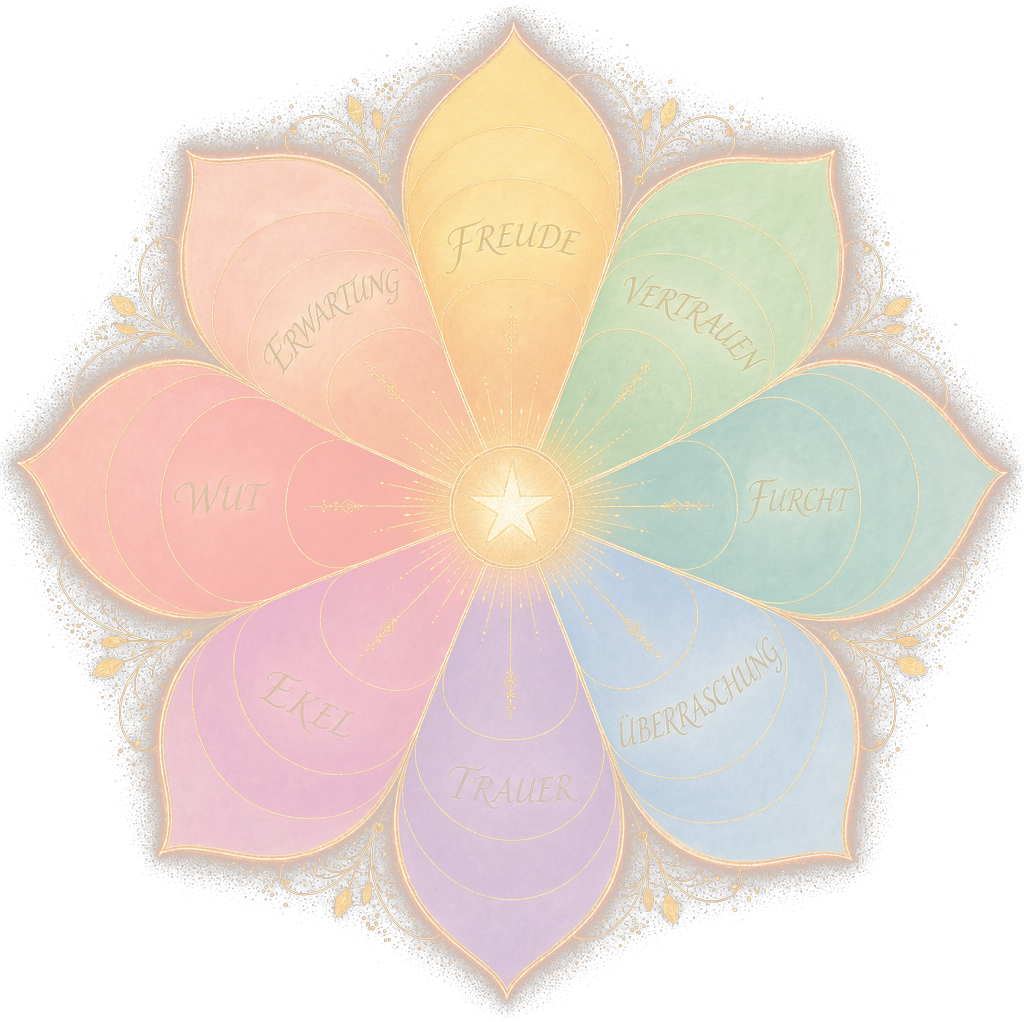
The wheel shows eight base emotions, each in three degrees of intensity — from the outermost, faintest hint to the innermost, most intense form. Opposite sectors are true opposites (e.g. joy ↔ sorrow): not experienceable simultaneously.
Click a sector or tab through with the keyboard (arrow keys navigate, Enter opens). You receive examples, mixed emotions with neighbours, and the scientific evidence for each feeling.
Plutchik 1980 · Cowen & Keltner 2017 replicated with 27 emotion categories, 8 of which are cluster centres — identical to Plutchik's original. Cross-culturally validated (Cordaro et al. 2024, 26 countries).
Rasa theory from the Nāṭyaśāstra (India, ca. 200 BCE): 8 (later 9) base feelings (rasas) — almost one-to-one with Plutchik. A theatrical doctrine that anticipated the research by 2,200 years.
What tradition described as rasa is today operationalised as emotion clusters. Application: emotional granularity (Feldman Barrett 2017) — the finer you can feel, the more regulated you become.
Which dyad arises from joy + trust?
From 8 base emotions arise 8 molecules. Choose a blend — see how tradition, research and experience meet.
Feldman Barrett showed: those who can name feelings more finely regulate themselves better. Write a vague feeling — the Seer asks back until the more precise word becomes visible.
Granularity meint die Fein-Auflösung, in der du deine Feelinge wahrnehmen und benennen kannst. "Schlecht" ist niedrig-granular — es beschreibt einen ganzen Zustand-Cluster ohne ihn aufzuschlüsseln.
Höhere Granularity wäre: "verlassen", "übersehen", "nicht-gemeint" — drei verschiedene Erfahrungen, die alle unter "schlecht" sortiert worden wären. Wer differenzieren kann, kann auch gezielter handeln: das, was bei "verlassen" hilft, ist nicht das, was bei "übersehen" hilft.
Lisa Feldman Barrett zeigte in fMRI- und Tagebuch-Studien: höhere Granularity korreliert mit geringerer Affekt-Dysregulation, schnellerer Erholung von Stress, weniger Risiko-Verhalten. Es ist trainierbar — und genau das tut dieses Werkzeug.
Cowen & Keltner (2017, PNAS) had 853 participants rate 2,185 emotion-loaded videos. Factor analysis found not Plutchik’s eight — but 27 distinctly experienced affect clusters, spanned between valence and arousal. Here is the map.
What you think you are is a constructed map. As constructed as the periodic table — and just as useful. But never identical to what is actually there.
Do you know it — when someone describes you, and you think "that is not who I am"? You have a different map of yourself than they do. Both maps are partial. The question is not which is correct — but: which one serves the experience right now?
Self-concept research (Markus & Wurf 1987 → Robins 2024): we hold multiple self-schemata in parallel, activated situationally. The working self-concept is not stable but fluid.
Buddhist teaching of anattā (non-self): the fixed I is a construction. Hinduism: ātman as the observer behind the maps. Both traditions: recognise the map, then work with it without identifying as it.
Mindfulness research (Vago & Silbersweig 2012, updated): experienced meditators show reduced DMN activity during self-reference — their map is lighter, because they do not mistake it for reality.
Describe yourself in three sentences. Then read the first sentence again and ask: is that the map, or the territory?
C.G. Jung spoke of the ego-Self axis: day-consciousness (ego) in relation to the integral whole (Self). Both are needed. The axis is the movement between them.
Do you know the moment when you make a decision — and at the same time sense that something deeper already knows? That is the axis. Your ego decides. Your Self knows. Both are at work.
Individuation = the lifelong movement between the poles, not toward either of them.
IFS studies (Schwartz · Hodgdon 2022, current): the Self as therapeutic anchor — when the client speaks from Self, physiological arousal drops on average 22% within a session.
Sufism: nafs (self-ego) versus rūḥ (soul). Christian mysticism: the True Self behind the False Self (Thomas Merton). Structurally the same polarity everywhere.
Modern model: Self-Leadership (Schwartz 2021, IFS) as therapeutic goal — the client learns to speak from Self rather than from a Part. This is Jungian individuation, operationalised.
Sphere C showed you the architecture: window, quantum hypothesis, 27 emotion clusters, your inner map as map. Sphere D asks after the edges of that architecture — where your field meets the field of others, where the shadow returns, where consciousness no longer seems merely local. Four phases that lead into the completion of the Inner Mandala.
Since 2008 the Global Coherence Initiative has measured the earth's magnetic field at 12 locations worldwide — and correlated it with collective events. The research is hotly contested. We present both sides honestly.
Do you know the phenomenon of sinking deeper in a group meditation than alone? That is measurable: collective HRV synchronisation in practised groups (Vieten et al. 2018). What is not measurable: whether the field reaches someone who is not in the room.
HeartMath GCI 2024 finds correlations between solar activity and HRV patterns (n=104, r=0.31). Independent-lab replication (Mayer 2022) shows smaller effects. Mainstream science remains reserved.
Buddhist practice: mettā (loving-kindness) has been directed at the not-present for 2,500 years. Sufism: himma as spiritual force that acts across distance. Tradition claims reach. Science does not show it.
Here we are at the edge. Local (co-regulation in the room) is established. Non-local (reach across distance) is not replicated by current standards. We honestly suspect: maybe. We do not claim.
Jung called it shadow — everything in you that you refuse to own. Ken Wilber's 3-2-1 process makes it accessible: in three steps the banished returns. We walk you through — carefully.
Do you know that one person who annoys you disproportionately? More than their behaviour objectively warrants? Jung says: a mirror hangs here. What you see in them and cannot bear — you are it too, in the form that was not permitted to you.
IFS studies (Hodgdon et al. 2022, J. Aggression, Maltreatment & Trauma): parts-work shows clinically relevant effects on PTSD symptoms and self-compassion. Quantitative shadow research in the narrow sense remains rare — the effect is better documented in clinical practice than in RCTs.
Sufism: Nafs al-Ammāra (the commanding self) must be recognised, not fought. Christian mysticism: the fall through rock of one's own shadow sides. Hindu sādhanā: encounter with one's own asuras.
What tradition described as spiritual duty is today therapeutically effective. IFS (Schwartz), Voice Dialogue (Stone) and Wilber's 3-2-1 method all work from the assumption: integrate rather than get rid of.
Mirror to Elements · The Dark Universe Dark matter · what acts but does not shine · outside invisible mass, inside invisible partWhat you despise in others sometimes hangs on a mirror.C.G. Jung · 1934 · GW 9/II
Rupert Sheldrake posited morphic fields — memory structures that act across generations without genetic storage. Mainstream biology rejects this. We present both sides.
Do you know the phenomenon of a practice (meditation, sport, a language) suddenly becoming easier — as if thousands before you had smoothed the path? That is the experience Sheldrake wanted to explain. We stay open.
Sheldrake's morphic fields are a non-mainstream hypothesis. We present them honestly as what they are: an idea with explanatory aspiration but no hard proof. Mainstream biology rejects them.
What you can do here: see whether the described phenomenon resonates for you (sometimes that is more valuable than proof). Read the sources. Keep the question open.
Sheldrake's hypothesis is methodologically problematic — not directly falsifiable in a strict Popperian reading. Replication attempts (e.g. new crystallisation rates, IQ trends, language-learning curves) are mostly negative or at best inconclusive. Mainstream biology does not count morphic fields among established phenomena — we take them here as historical hypothesis, not research consensus.
Jung's collective unconscious posits shared archetypal structures. Akashic records (theosophical): cosmic memory. Structurally similar, methodologically untestable.
What is empirically defensible: cultural transmission, epigenetic inheritance (Yehuda 2016 Holocaust studies), mirror-neuron-based transmission. What goes beyond — Sheldrake's claim — remains speculative. We say: maybe.
Penrose-Hameroff's Orch-OR hypothesis (Orchestrated Objective Reduction) says: consciousness is a process in geometric quantum structure — not a thing, not a substance. This is not proven. But it is the only theory that takes phenomenology seriously.
Do you know the moment in deep meditation when consciousness appears no longer local — as if no point remained at which you are? Penrose would say: here the geometric basis becomes visible, normally hidden by the day-self. Phenomenologically: consistent. Scientifically: open.
This phase is speculative. Orch-OR (Orchestrated Objective Reduction) is Penrose-Hameroff's attempt at the Hard-Problem-of-Consciousness — consciousness as a geometric process, not a substance. Phenomenology fits, falsification pending.
What you can do here: read the phenomenology block, compare with your own experience in deep meditation or at the threshold of falling asleep. Keep the question open. Speculation is allowed when it is marked as such.
Babcock & Kalra (2024, J. Phys. Chem. B): correlation between anaesthetic action and possible quantum effects in microtubules — Hameroff's prediction was not falsified. Tegmark (2000) disputed it theoretically, more recent studies push back partially. The debate remains open.
Vedanta: Cit as non-substantial consciousness. Madhyamaka Buddhism: śūnyatā as emptiness of any substantial identity. Structurally compatible with a non-classical basis. Tradition demands it.
The hypothesis is the most honest model we have — because it does not explain away the hard problem. Whether it is correct, no one knows. What it shows: science and mysticism may meet without one foreshortening the other.
Four codex plates in alchemical engraving style, each an aspect of the Orch-OR hypothesis: vacuum fluctuation, quantum coherence in the microtubule, objective reduction, and the geometric consequence in experience. Hermetic, dense, abstract.
This is a postulate-tableau — not data, but a pictorial sense of what Penrose and Hameroff might mean. Read slowly, one plate at a time. It need not be conclusive at once.
Vacuum fluctuation. Indeterminacy of subspace structure. Hameroff: here proto-choice may begin.
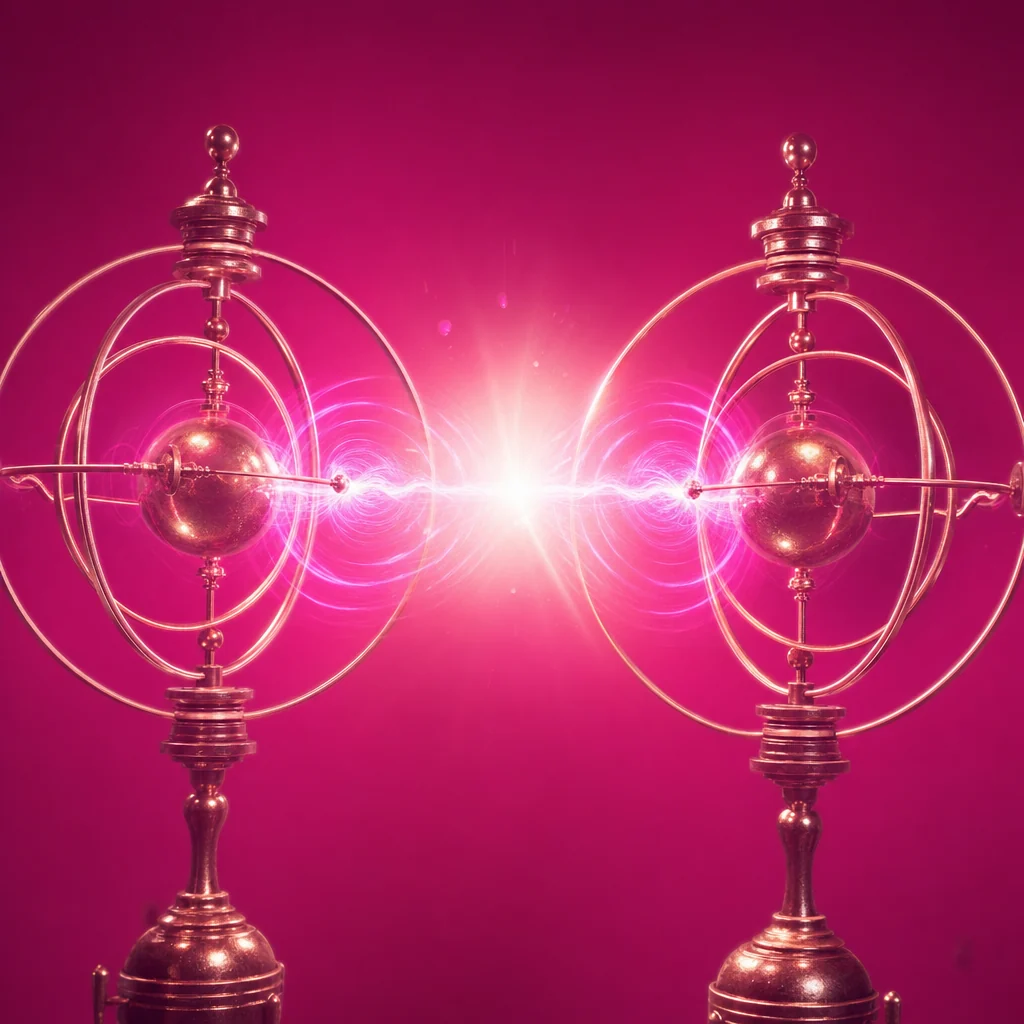
Synchronisation of two oscillators. In microtubules: coherent states up to ~25 ms — Penrose's 1989 prediction.

One frequency produces overtones. Every primary experience structurally carries follow-experiences within it.
Sudden amplification at resonant frequency. The "moment of recognition" as resonance-spike in the microtubule network.
Generated directly in your browser via the Web Audio API — no files, no tracking. The three-layer discipline applies here too: what is measurable, we say. What tradition claims, we mark.
200 Hz left, 210 Hz right. Difference = 10 Hz, alpha range. Put on headphones. Meta-analysis (Garcia-Argibay 2019, 22 studies): small but consistent effect on attention.
Tibetan singing-bowl frequency with natural overtones. Goldsby 2017 (RCT, n=62): significant for stress & mood (d=0.6-0.8). Replicated 2023.
The most popular Solfeggio frequency. Claims about DNA repair are not peer-reviewed. What works: any calming music calms HRV — that is established.
Deep drone from two sine tones (C3 + G3 · perfect fifth). Slows breathing. Telles et al. 2019 (RCT): regular om-practice reduces HRV LF/HF ratio.
1/f noise — natural acoustic carpet, helps with falling asleep and concentration. Suzuki 2017 (RCT, n=13): deeper sleep phases, improved memory consolidation.
What you hear above with the Web Audio API, humans have practised for millennia with physical sound. Each of these tools uncouples the body from the beta-waking mode and leads it into measurable HRV coherence.
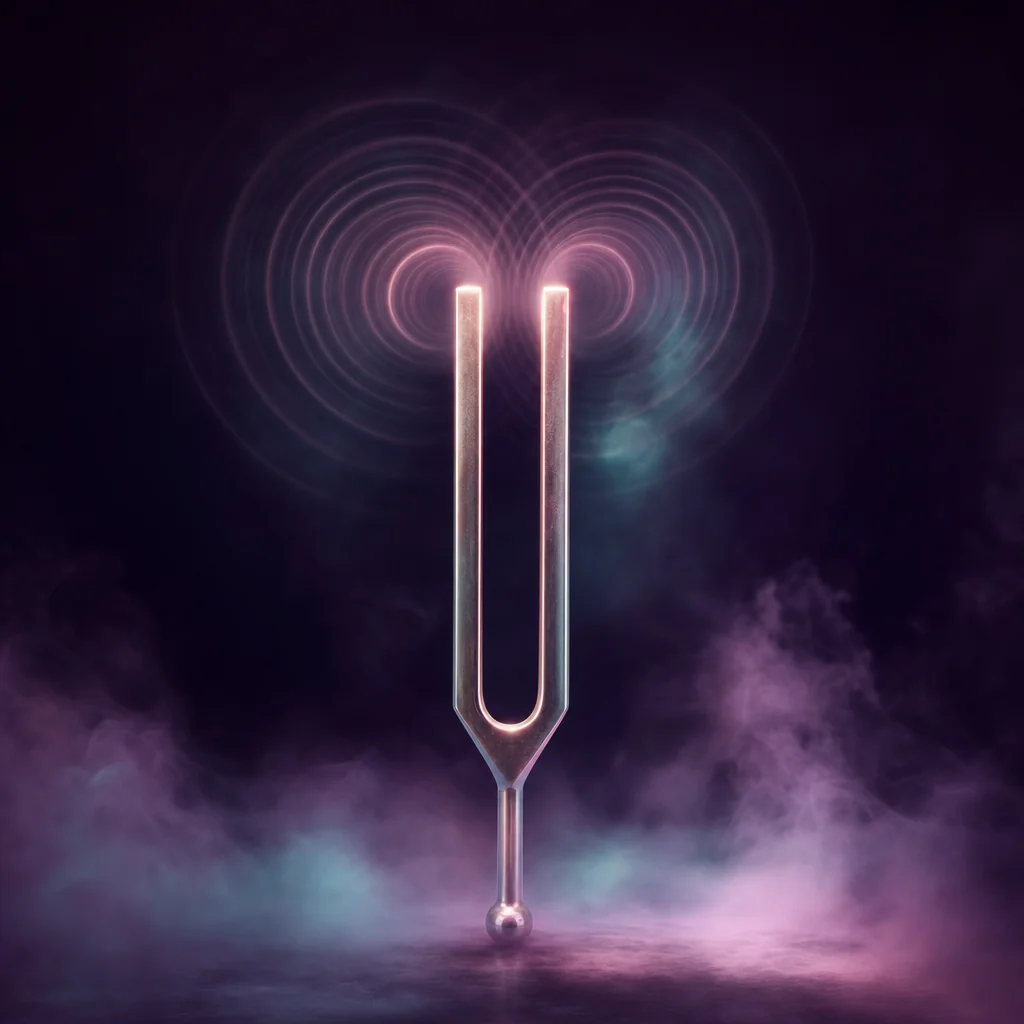
Pure sine tone, felt in the body. Frequency therapy uses it at acupuncture points — small but replicated.
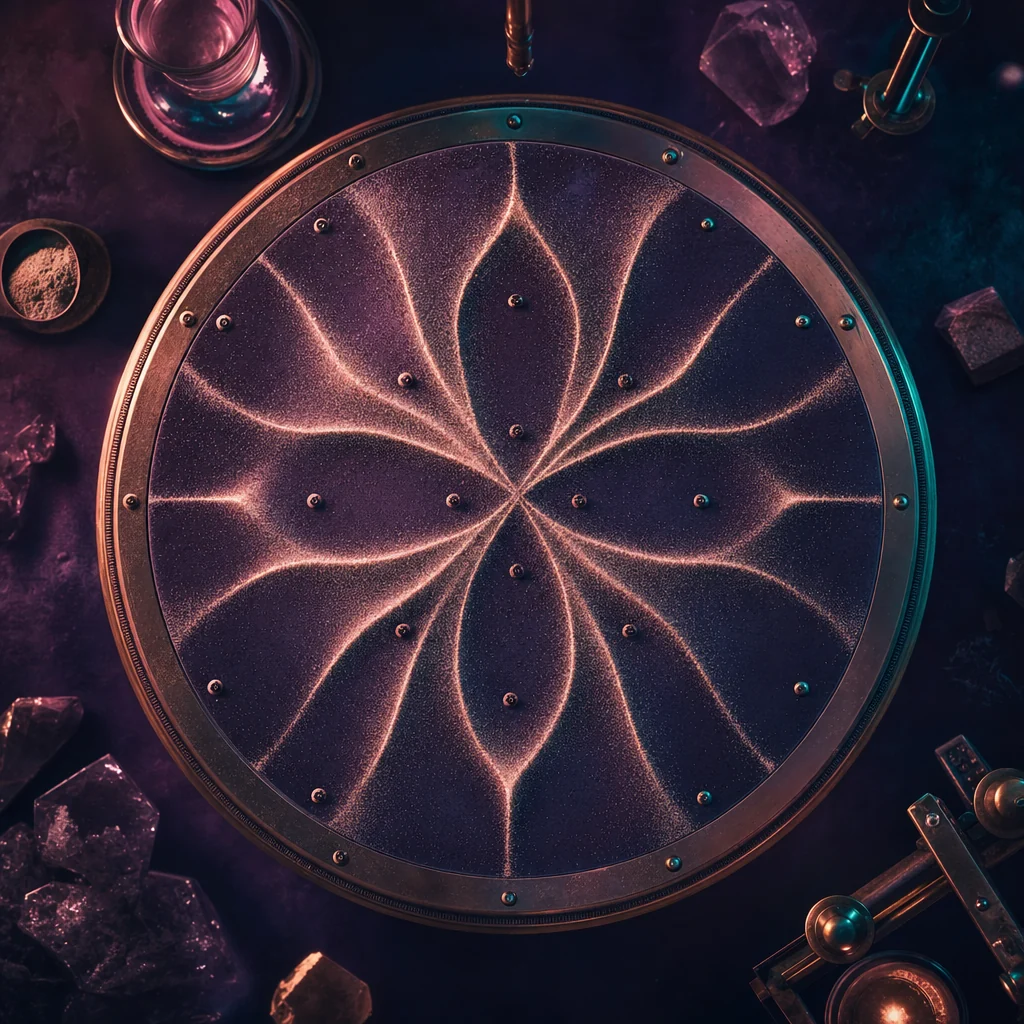
Sand on a vibrating plate forms geometric patterns per frequency. Makes visible that vibration is form.
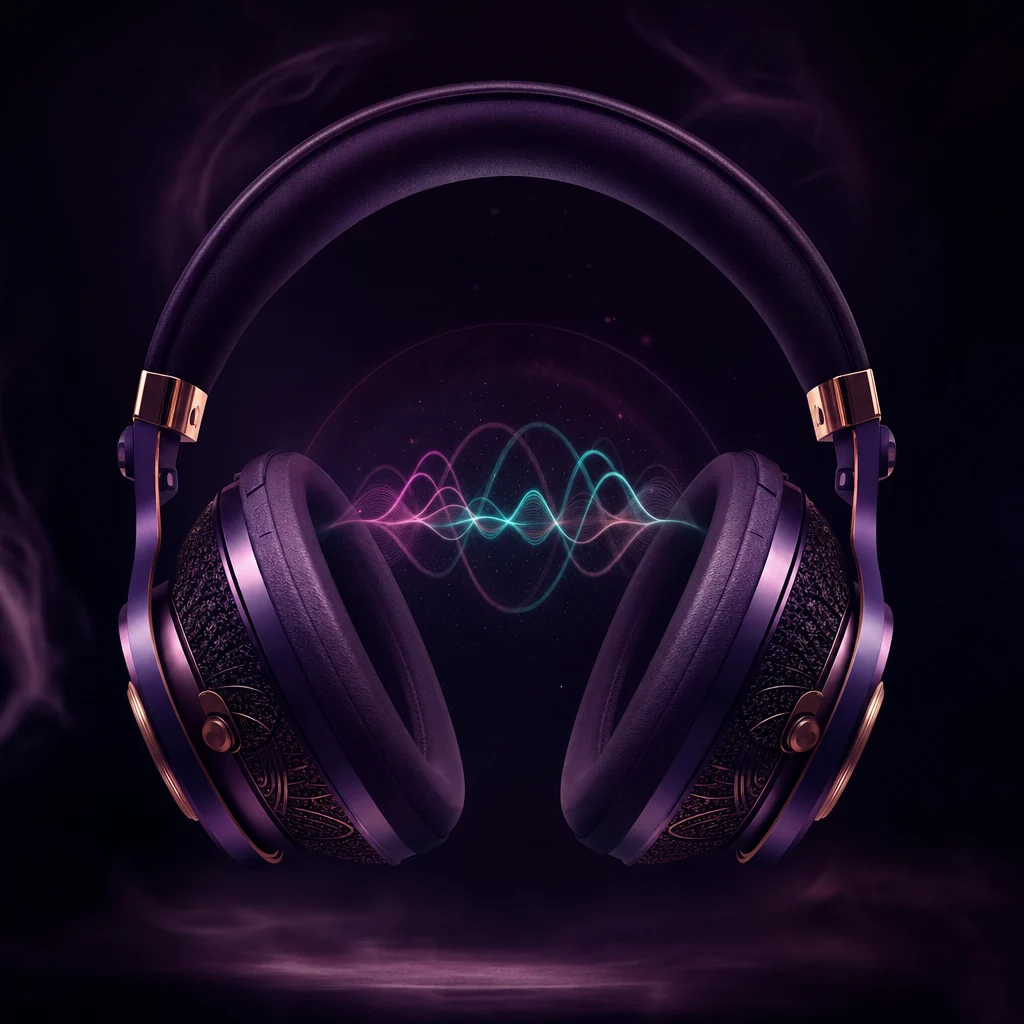
Binaural hearing only works in stereo isolation. Over-ear > in-ear for binaural effects.

Heart rate variability — the objective measure of autonomic balance. Sound practice raises HRV coherence.
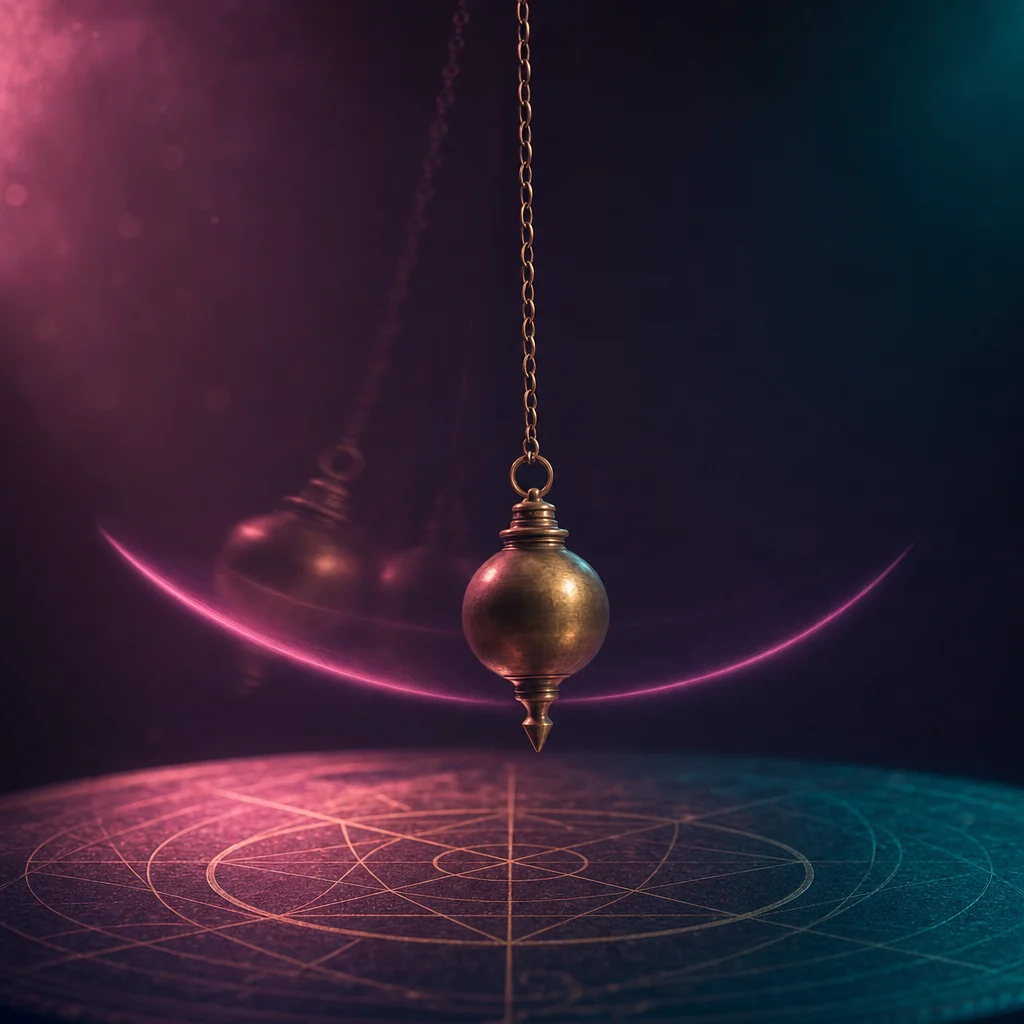
Two pendulums of equal frequency synchronise via wall coupling — Huygens' original finding.
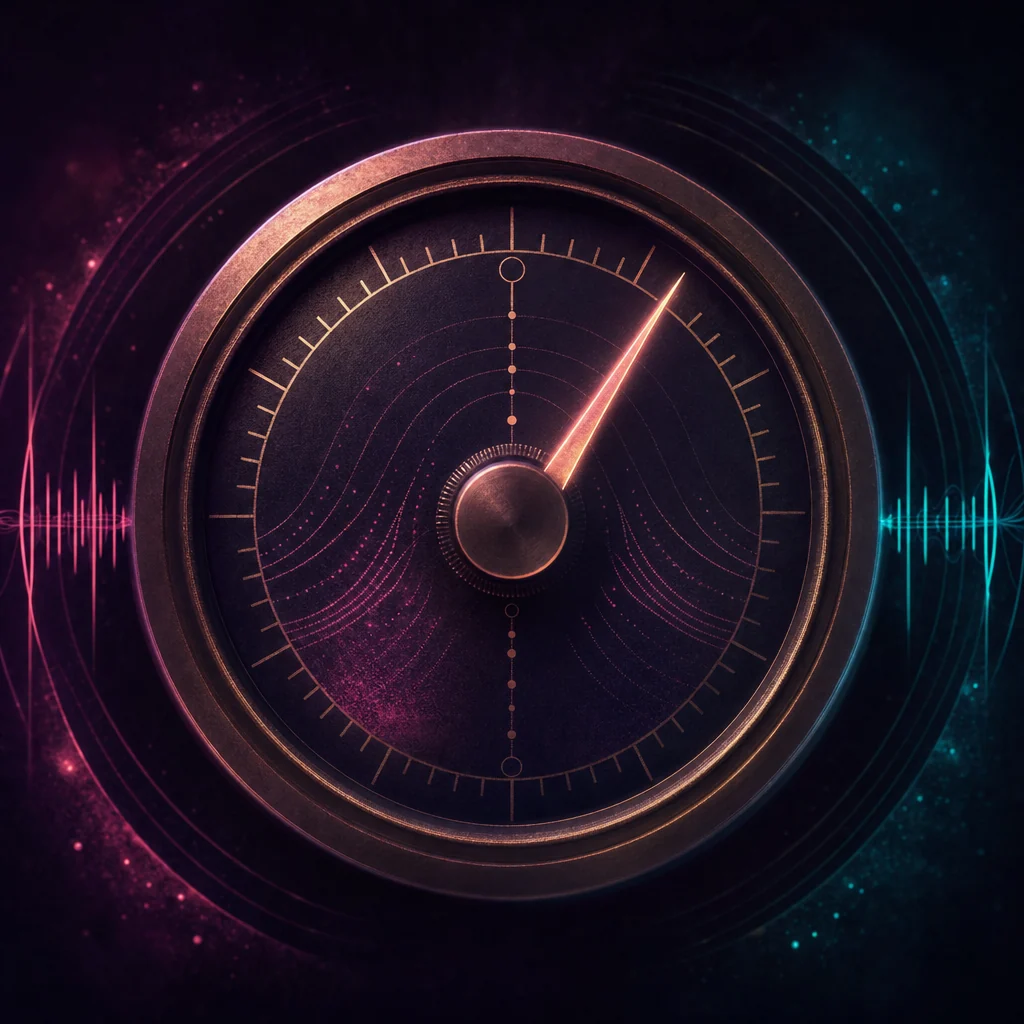
Electronic oscillation source — generates pure sine/square waves. The Web Audio original. Here digital, there analog.
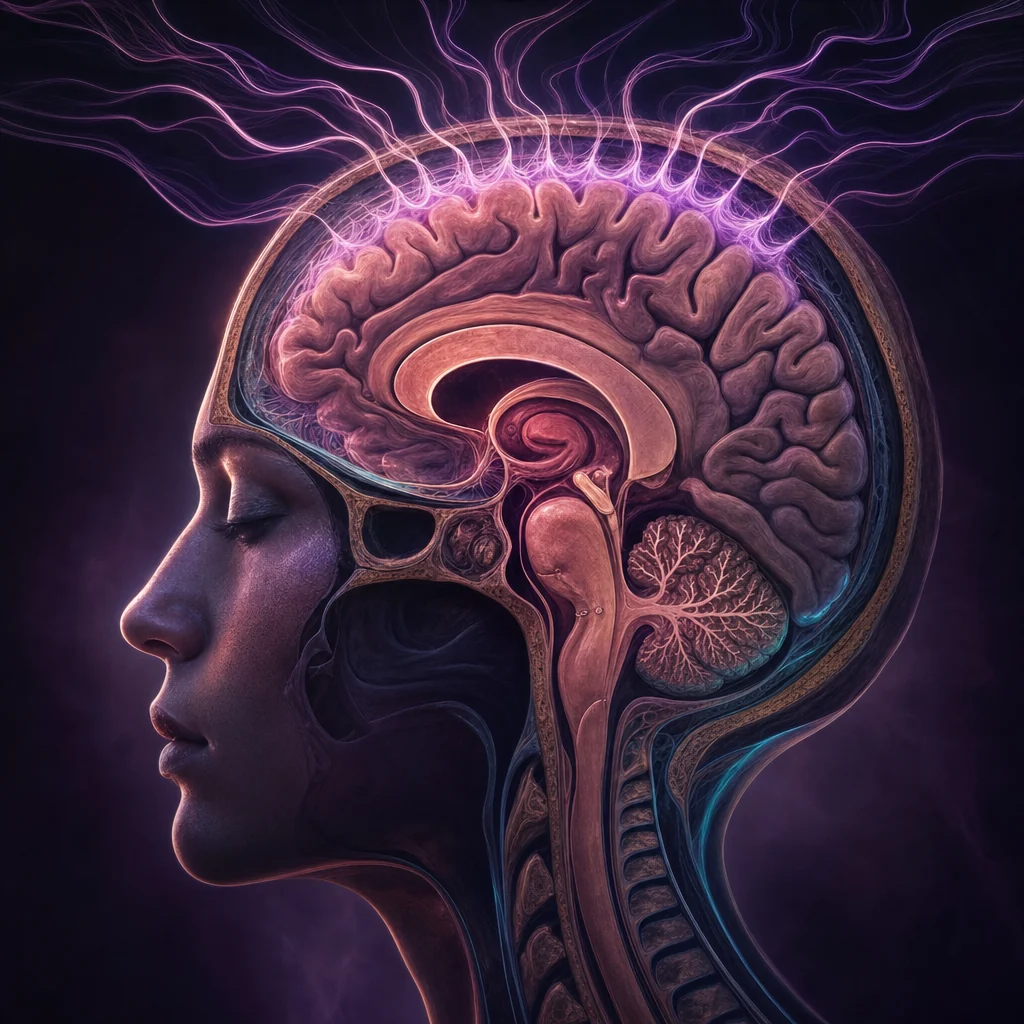
Sagittal section through the cortex. Where sound first arrives: Brodmann 41/42, primary auditory cortex.
At Elements the path ended with the Merkaba — outer completion. Here it ends with the Inner Mandala — its counterpart. Vesica Piscis, Flower of Life, Star Tetrahedron. Ancient geometry, freshly lived.
It is the recognition that map and territory coincide once you stop mistaking the map for the territory.
The geometry shows: Vesica Piscis (two overlapping circles) is the fundamental form from which the Flower of Life arises. From it emerges the star tetrahedron — the Merkaba in 2D projection.
You have walked twenty phases. What remains? Write one sentence you want to keep.
Periodic table · microtubule-quanta · values-spiral · Merkaba. Four quadrants — the same space. What was geometry outside is geometry inside too.
Describe in one sentence what you are carrying right now. The Seer weighs a phase-essence, a lifeforce, a geometry — and from these draws your sigil. What becomes visible is not a prediction, but a form that mirrors your intention.
Eine Sigille (lat. sigillum, "Siegel") ist ein verdichtetes Zeichen für eine Intention. In der alten Magie war es ein per Hand gezeichnetes Symbol, das Wunsch und Form verband; in chazon ist es eine algorithmisch komponierte SVG-Geometrie aus Phasen-Essenz, Lifeforce-Modus und Element-Tradition.
Du beschreibst in einem Satz, was du gerade trägst — the Seer wählt drei innere Achsen aus 20 Phasen und 5 Elementen, baut daraus die Linien deiner Sigille und ergänzt eine kurze Lesung. Das Ergebnis ist keine Vorhersage, sondern ein Mirror deiner Intention in Geometrie.
Du kannst die Sigille als PNG speichern, in deinem Codex bewahren oder löschen — sie wird nicht serverseitig persistiert.
Choose one of the twenty phases. The Seer generates a 60–90-second guided voice-walk in her voice — with three breath pauses built in. No screen, no buttons while you walk. Only breath and voice.
Ein Voice-Walk ist kein Audio zum Anhören, sondern eine Anleitung zum Gehen. Du wählst eine Phase, the Seer generiert dazu einen 60–90-Sekunden-Pfad mit drei eingebauten Atem-Pausen — und du gehst sie tatsächlich, im Raum oder am Fenster.
Während des Voice-Walks zeigt der Bildschirm nur eine pulsierende Sphäre — keine Buttons, keine Steuerung. Das ist Absicht: du sollst nicht ablesen, sondern hören und gehen. End bricht jederzeit ab.
Nach dem Gehen kannst du eine kurze Notiz (Insight) speichern — sie landet in deiner Memory und beeinflusst, was the Seer dir später in der Mirrorkammer zurückspiegelt.
A phase from your inner manuscript. An element from Mendeleev's table. The Seer forges a three-layered synthesis from both: Tinctura (what happens outside chemically) — Psyche (what happens inside in parallel) — Sigillum (how the merged glyph would look). For the first time the two sister sites speak to each other.
Describe in two or three sentences what is carrying you right now — a question, a hesitation, a threshold. The Seer locates this situation on the spiral, names the shadow pole and the bridge forward — plus three very concrete micro-rituals for today, quiet and bodily.
A five-part mirror journey — phase, element, feeling, granularity, question. From your five answers the Seer composes a full folio page of a Codex Lumens manuscript: initial, incipit, main verse, marginalia, colophon. With its own Codex signature. Downloadable as PNG.
Some phases you held long, others briefly, some skipped. In the workshops you composed works — sigils, syntheses, positions, folios. The Mirror Chamber reads what is taking shape and reflects it back: three stanzas in the Seer's voice, contemplative, not diagnostic. The snapshot is sent once and discarded immediately. If you wish — we listen together.
Opens the Memoria panel with the mirror request — you confirm what is sent.
You have seen the values-spiral, entered the Default Mode Network, distinguished the five feeling-types, recognised the three inner devices, felt the heart-field, understood mirror neurons, mapped six virtues, walked the spiral as a path, traversed thirteen billion years of consciousness, found your Window of Tolerance, wrestled with microtubule-quanta, explored Plutchik's mandala, recognised your inner map as map, named the ego-Self axis, queried heart-reach, worked in the shadow, considered living fields, looked at Orch-OR, played the Resonance Studio — and finally entered the Inner Mandala.
This map keeps breathing. What is still to come are layers on Shalem-Merkaba, Ayurveda, Tibetan medicine, depth psychology, hypnosis, sound therapy and shadow work. The spiral is not finished — it circles.
What you have now is the skeleton. What we shape further together is the skin.
What was drawn here as 20 phases within stands there as 118 elements without — the same geometry, the other axis.
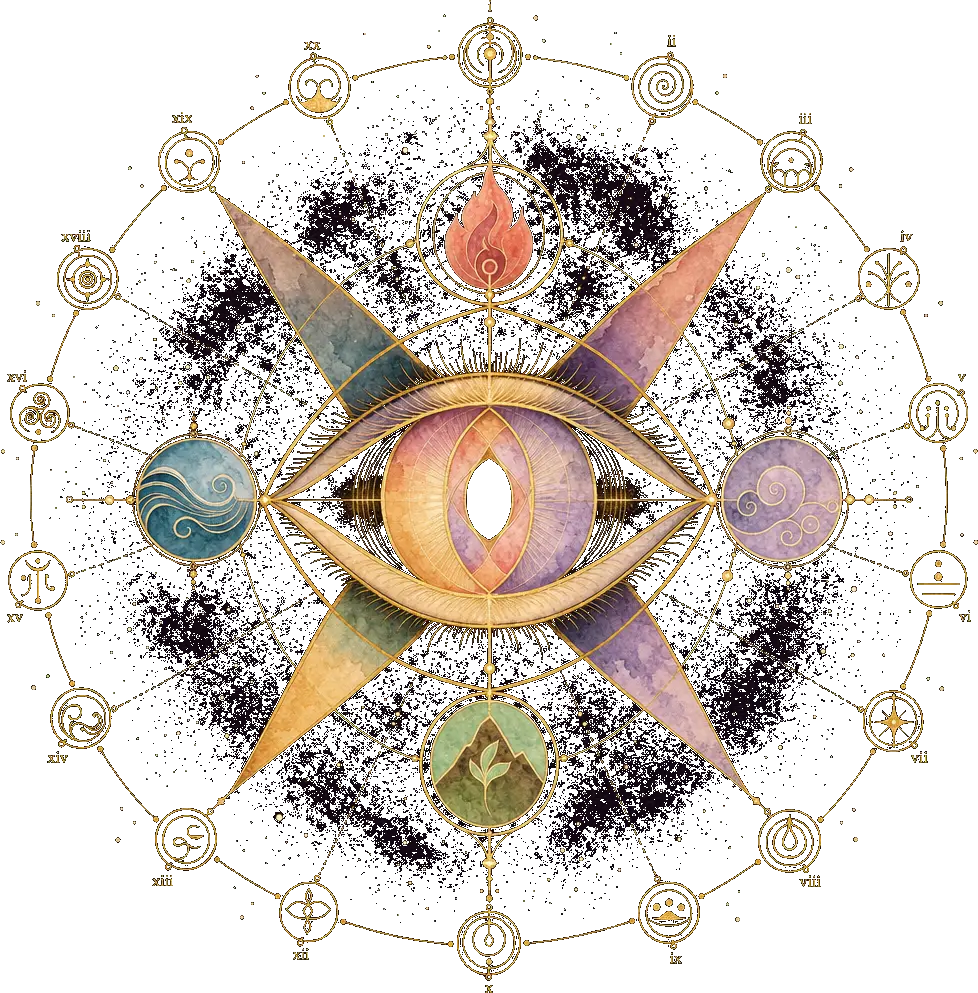 Follow the image · chazon · elements · the outer cosmos