Femininity · Fusion
Eye to Eye
Not one above the other, but the feminine and the masculine as two equal forces of one whole human being.
This study brings both poles onto one line: from spirituality through physics, medicine and artificial intelligence right into your own relationship and the inner conflict between feeling and thinking. It carries the cause of women's rights further, toward the human being as a whole.
Listen (read by Mira)
CHAZON STUDIO · Video in German
Eye level on film
A film by Chazon Studio. Further episodes will appear here once published.

Augenhöhe: Was die Daten über Männer und Frauen wirklich sagen
Open on YouTube ↗
I · The Principle
Two poles, no hierarchy
Goethe called the fundamental movement of nature “polarity and intensification”: two opposing forces that do not fight each other but depend on each other, and whose tension brings forth something third, something higher. Magnet and magnet, breathing in and breathing out, light and darkness. In this reading, the feminine and the masculine are not two kinds of human being but two principles that live in every person.
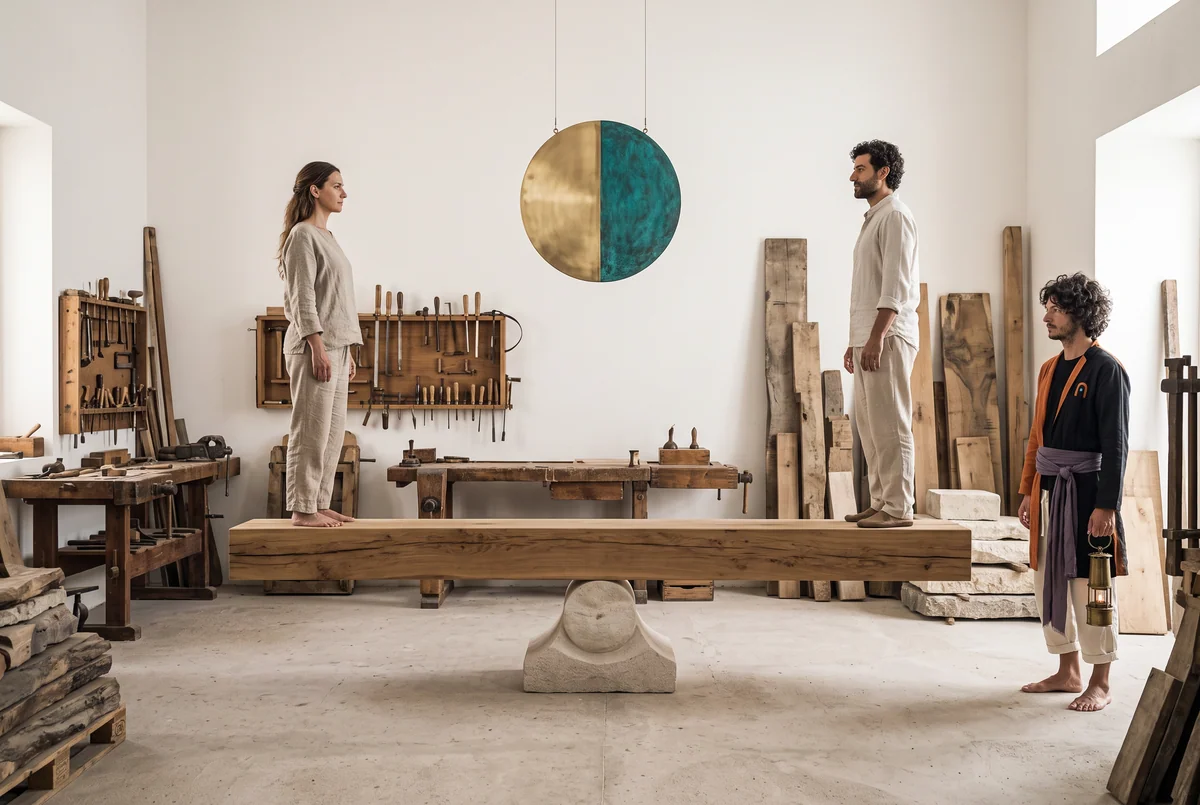
Important note up front: “feminine” and “masculine” here mean archetypal poles (receiving and shaping, circling and directed, devotion and will), not a prescription for how real women or men ought to be. Every person carries both poles in their own blend. The concern is the rehabilitation of the long-devalued feminine pole and its reconciliation with the masculine, within each person.
Equilibrium
Eye to eye: the whole human being
Both forces hold each other in balance. Will and devotion, analysis and intuition, structure and flow work together. Here there is neither patriarchy nor matriarchy. Here there is connection.

II · Spirituality
The silenced divine feminine
Almost every great tradition knows a feminine side of the divine, and almost every one has pushed it to the margins. Where the masculine principle (logos, law, transcendence) was idealized, weakness, feeling and devotion counted as “inferior”. Reclaiming the feminine does not mean romanticizing it, but recognizing it as an equal path to the sacred.
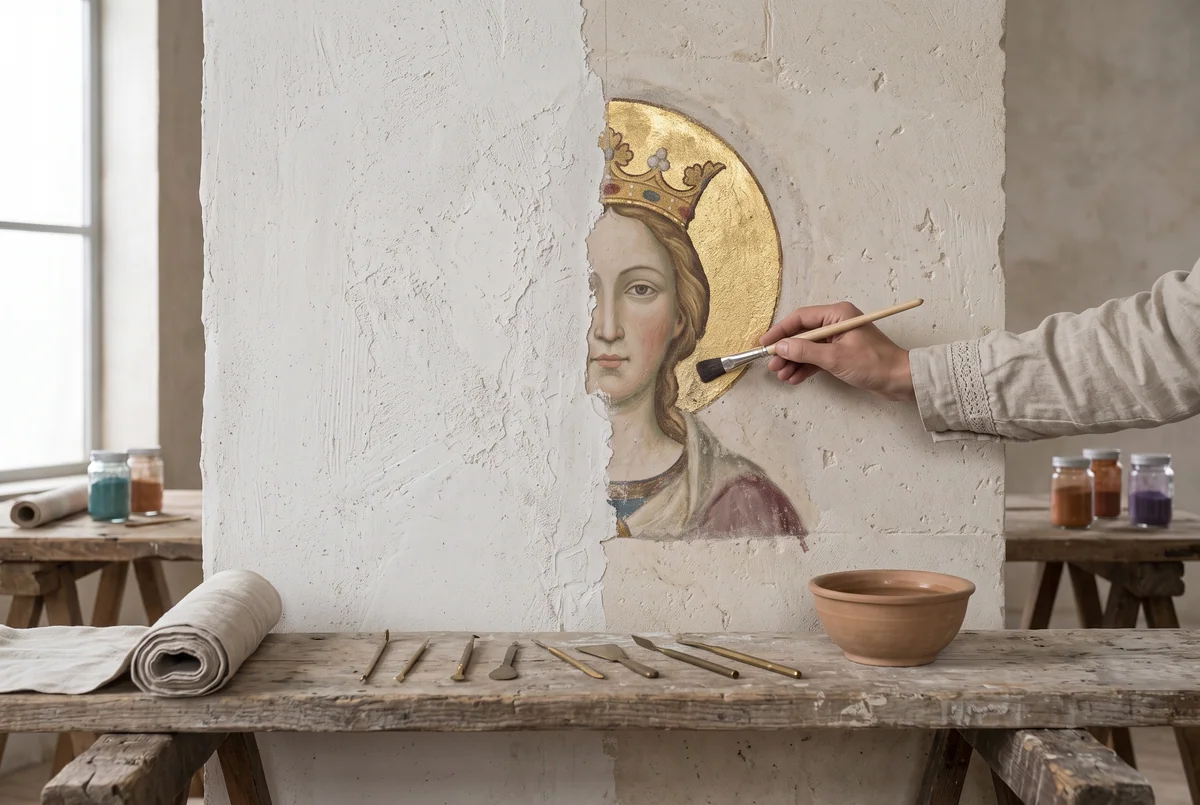
Shekhinah, Sophia, Shakti, the Great Mother: four names for a force that does not merely think the spiritual but carries it lovingly.
01
Shekhinah
In Judaism, the “indwelling” presence of God: imagined as feminine, close to the people, suffering with them. Kabbalah sees her exile as the wound of the world, her homecoming as its healing.
02
Sophia
The divine wisdom of Gnosis and anthroposophy. Bearer of a knowing that does not merely dissect but beholds with love.
03
Shakti
In Tantra, creative energy itself. Without her, Shiva, pure consciousness, remains lifeless. Only the two together are reality.
04
The Great Mother
Erich Neumann describes her as an archetype: nourishing and devouring at once. Splitting her off produces a culture that fears the living.
“The Eternal Feminine draws us upward.”

III · The Inner Conflict
Feeling and thinking
The deepest arena of this polarity is not society but one's own interior: the quarrel between head and heart, between cool analysis and warm intuition. A culture that crowns only the intellect declares feeling a disturbance and grows poor. One that only feels loses clarity. Maturity means letting both speak.
Feminine pole↔ SynthesisMasculine pole
Knowing
Intuition · sensation
Contemplation
Knowing
Logic · analysis
Time
cyclical · circling
Spiral
Time
linear · directed
Movement
Receiving · devotion
Breath
Movement
Giving · will
Form
Flow · dissolution
Gestalt
Form
Structure · boundary
The neuropsychiatrist Iain McGilchrist describes two ways of meeting the world: one open, contextual, relational, and one focused, dissecting, grasping. His finding: in modernity, the second has displaced the first and made itself the sole ruler. Antonio Damasio showed at the same time that there is no reasonable decision-making without feeling. “Pure reason” is a fiction.

IV · Physics as Parable
Matter & antimatter
Physics, too, knows polarity and a famous imbalance. At the Big Bang, matter and antimatter should have arisen in equal amounts and annihilated each other completely. That a world exists at all is owed to a tiny asymmetry in favor of matter. Pure symmetry would have yielded nothing; pure one-sidedness too. Life arises in the fertile field of tension.
From the breaking of perfect symmetry a world emerges. One tiny lasting asymmetry is enough to seed a galaxy.
Complementarity
For Niels Bohr, particle and wave do not exclude each other: both descriptions are needed, neither alone is “true”. A model for two poles that need each other.
Symmetry breaking
It is precisely the breaking of perfect symmetry that creates difference, information, world. Complete sameness would be frozen; living difference is creative.
Tension as source
Just as plus and minus poles generate a current only together, a person draws strength not from abolishing the opposite pole but from acknowledging it.
Deliberately meant as a parable, not as physical proof of statements about the soul. Natural science offers an image for an old insight: from pure sameness nothing arises; from the pure rule of one pole, violence arises.

V · Science & Medicine
Research by and for one pole
Where the idealization of the masculine principle becomes concrete and measurable: for decades, the male body counted as the “standard human”. Women were excluded from clinical trials as “complicated”: because of the menstrual cycle, possible pregnancy, hormonal fluctuations. The result is the gender data gap: diagnoses, dosages and guidelines that fit women less well.
- Kennzahl
- <30%
- Share of women in industry-sponsored early-phase clinical trials.
- Kennzahl
- 41%
- Share of women in cancer trials, although women carry 51% of the disease burden.
- Kennzahl
- 8–10 yrs
- Average time to an endometriosis diagnosis; symptoms are often dismissed as “normal”.
The heart attack as a “men's disease”
For a long time, the picture of the heart attack was modeled on male symptoms. Female signs (nausea, exhaustion, back or jaw pain) were overlooked for decades or filed away as psychosomatic. Across numerous conditions, women are diagnosed later than men.
Stereotypes as diagnostic bias
Linking femininity with “emotional instability” shapes how symptoms are perceived and documented. Women's pain is more often played down. Gender images reach all the way into the consulting room.
It cuts both ways
Gender-sensitive medicine benefits both poles. Depression, for instance, is often missed in men because it shows differently (as aggression, say) and men seek help less often. Eye to eye means researching the whole human being, not half of one.
Since 1993 (USA) and 2004 (Germany), the inclusion of women in clinical trials has been required by law; funding programs now actively work on closing the gap. It is real, and it is slowly shrinking.

VI · Artificial Intelligence
The imbalance, cast in code
Artificial intelligence learns from the past and thus from its one-sidedness. Where training data is dominated by one pole, the machine cements the imbalance and scales it into the future. A UNESCO study (2024) found pervasive gender stereotypes in large language models: women were linked with “home”, “family”, “child”; men with “executive”, “career”, “business”.
The “mom penalty”
AI hiring tools read gaps in a résumé (for care work, say) as negative. What builds competence is turned into a flaw by the algorithm.
Credit & capital
Learning algorithms in finance rate women as creditworthy less often and offer worse terms, a digital hurdle on the way to economic independence.
Medical AI
Trained on male-heavy data, diagnostic AI orients itself toward male symptoms. The gender data gap continues, automated.
Digital violence
Generative models fuel non-consensual fake nude images (“deepfakes”) that overwhelmingly target women and girls. Sexualization at the push of a button.
A responsibility lies here, for everyone who builds AI, too: diverse data, transparent algorithms, mixed development teams. An AI at eye level would be one that knows both poles instead of amplifying only one.

VII · Encounter
Your own relationship
On the large scale it is politics; on the small, the daily togetherness of two people. Eye to eye in love does not mean that both become the same. No flattening of differences. It means: two different poles meet without one administering the other. The tension between them is not the problem but the source of attraction.
in love
showing yourself · receiving
Encounter
in love
holding · protecting
in conflict
seeking closeness
Dialogue
in conflict
needing space
Strength
allowing vulnerability
Trust
Strength
holding clarity
The cultural devaluation of weakness, feeling and devotion hits men as well as women: it forbids one pole tenderness and the other self-assertion. A relationship at eye level gives both back to both.

VIII · Care & Economy
Those who carry are not honored
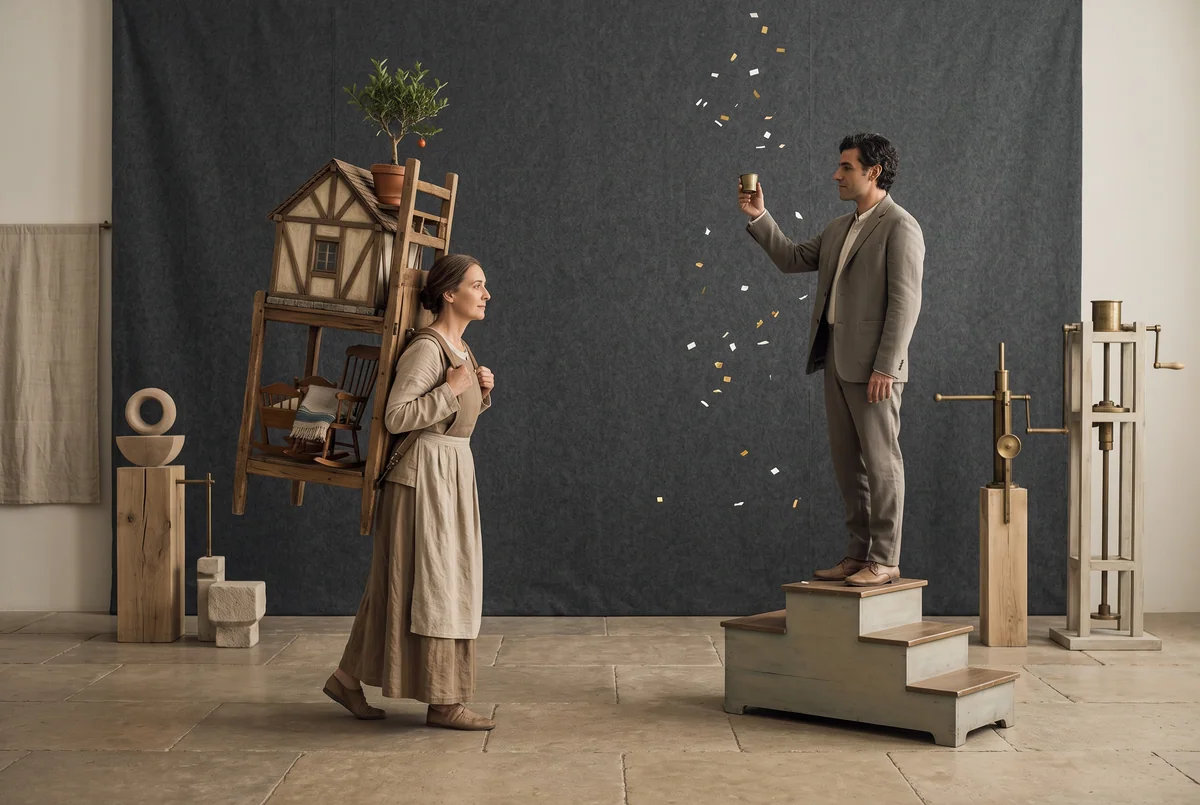
An economy that pays only the directed, productive pole devalues everything that carries, nourishes and tends: care work. At the same time it forces everyone into the same straight measure of time (“9–5 for all”), ignoring the cyclical, rhythmic pole. Yet this invisible work is the true foundation of every economy.
- Kennzahl
- $10.8T
- Value of women's unpaid care work per year, three times the size of the global tech industry (Oxfam).
- Kennzahl
- 16%
- Gender pay gap in Germany 2025: women €22.81, men €27.05 per hour.
- Kennzahl
- 37%
- “Labor market gender gap” 2025, including working hours and workforce participation. Equal Pay Day: February 27, 2026.
The hidden foundation
Every day, women and girls perform 12.5 billion hours of unpaid care work. It keeps every economy alive, and appears on no balance sheet.
The ignored rhythm
The female cycle, phases of strength and retreat, do not fit a rigid grid. Eye to eye would mean: align work with the human being, not the human being with the clock.
Thinking cooperatively
Cooperative models (Mondragón) show that an economy can build on participation instead of hierarchy: the connecting pole, taken economically seriously.
42% of women worldwide cannot take up paid work because they carry the care work, compared with 6% of men. By 2030, around 2.3 billion people will need care. Whoever fails to revalue care is heading for collapse.

IX · Power & Systems of State
Beyond domination
“Matriarchy just as bad. Patriarchy leads.” Both are forms of domination in which one pole holds power over the other. The question is not who rules but whether rule must be the organizing principle. Riane Eisler calls the alternative the “partnership model”: a society organized around connection instead of dominance: emblematically the chalice instead of the blade.
- Kennzahl
- 27.2%
- Share of women in national parliaments worldwide (2025), up from 11.3% in 1995.
- Kennzahl
- 25
- Countries with a woman as head of state or government. Portfolios such as finance, foreign affairs and defense remain male-dominated.
- Kennzahl
- 2063
- The year in which, at the current pace, gender parity in parliaments would finally be reached.
Dominator model↔Partnership model
Order through
Ranking & coercion
Balance
Order through
Connection & trust
Difference becomes
hierarchy
Equal worth
Difference becomes
complement
Historical evidence for egalitarian, mother-centered cultures (Marija Gimbutas) is contested in archaeology. What is not contested is the thought behind it: the equal worth of the poles is not a law of nature but a cultural decision and therefore changeable.

X · Religions
The repressed face
The monotheistic religions have cast the divine as predominantly male: Father, Lord, King. The feminine survived at the margins: as Mary, as Wisdom, as hidden tradition. Reform movements and mystical currents are bringing it back without losing the core.
Christianity: Mary & Sophia
Devotion to Mary became the vessel for the repressed feminine principle. Mystics such as Hildegard of Bingen and the Sophia tradition spoke of a feminine divine wisdom that co-creates.
Judaism: Shekhinah
The kabbalistic Shekhinah is the feminine, world-facing presence of God. Her union with the transcendent pole is held to be the aim of prayer: healing the split within the divine itself.
Hinduism & Tantra: Shakti
Here the feminine is no add-on: Shakti is the energy of the world. Without her, masculine consciousness (Shiva) is motionless. Only their union is reality.
Daoism: Yin & Yang
The clearest image of eye level: within the black lives a white dot, within the white a black one. No pole is pure, none exists without the other, and the two are constantly transforming into each other.
The image was allowed to be feminine, the office was not
Rich as the divine-feminine imagery is, institutional power remained male almost everywhere. The sacred was allowed a mother. The hierarchy that guards and interprets it was not.
Catholic & Orthodox churches
The priesthood remains reserved for men (reaffirmed in 1994 in Ordinatio Sacerdotalis). In 2021, Pope Francis opened the roles of lector and acolyte to women. Priesthood and diaconate remained male.
Orthodox Judaism, Southern Baptists, LDS
Ordination of women remains closed; the office of pastor or rabbi is reserved for men. Women who claimed the office were in some cases expelled.
Islam
There is no formal ordination; according to the traditional schools of law, women do not lead mixed-gender congregational prayer. A reform movement is expanding women's roles today.
The countermovement
Anglicans ordain women as priests and bishops; Reform and Reconstructionist Judaism ordain women rabbis (since 1972); about half of US Protestant churches ordain women; in 2024, the Greek Orthodox Church of Alexandria consecrated a deaconess for the first time in a long while.
The repressed face returns in the image: as Mary, as Wisdom, as Mother. Yet the office (who interprets, consecrates, decides) remains largely in one hand. A spirituality at eye level would therefore have to change not only its images but its form of power.

XI · Body & Dignity
From object to subject
Where the female body is reduced to beauty ideals, sexualization and availability, a human being is turned into a thing. Violence and abuse are the furthest end of the same logic: one pole treats the other as property. Dignity begins with giving the body back as a lived subject, not as an image, but as a life.
- Kennzahl
- 137
- Women and girls are killed worldwide every day by a partner or family member, one every ten minutes (UN, 2024).
- Kennzahl
- 50,000
- Femicides by partners or relatives in 2024 alone, 60% of all women killed.
- Kennzahl
- 11%
- of men killed die at the hands of someone close, compared with 60% of women. Home is not a safe place for everyone.
Beauty ideals
Standardized images turn one's own body into a perpetual list of defects. The gaze from outside replaces the feeling from within.
Women as objects
Whoever permanently appears as something to be looked at is denied an inside: will, desire, boundary.
Violence & abuse
The logic of ownership in its violent form. Protection, law and a different culture of the masculine belong inseparably to the answer.
Restoring dignity
Bodily self-determination means: each person has authority over themselves. That is the non-negotiable basis of any meeting at eye level.

XII · Earth & Creation
The same logic, writ large
Language gives it away: “Mother Earth”, “Mother Nature”. The same stance that wants to dominate the feminine also dominates nature, as raw material to be made compliant. Ecofeminism (Vandana Shiva, Carolyn Merchant) shows how the devaluation of the feminine and the exploitation of the earth spring from one root: the pole that only takes, without receiving.
Nature as object
Where the living counts only as usable matter, the only measure left is one's own advantage. The climate crisis is the bill for a logic of domination without a counter-pole.
From dominating to stewarding
The feminine pole thinks in cycles, relationship, generations. A culture at eye level with the earth nourishes back what it takes.
Who carries the burden
By 2025, up to 2.4 billion people live in regions facing water scarcity. Women and girls then walk even longer distances for water. The burden of the crisis is unequally shared.
What we do to woman, we do to the earth, and to ourselves.

XIII · Synthesis
The whole human being: the fusion
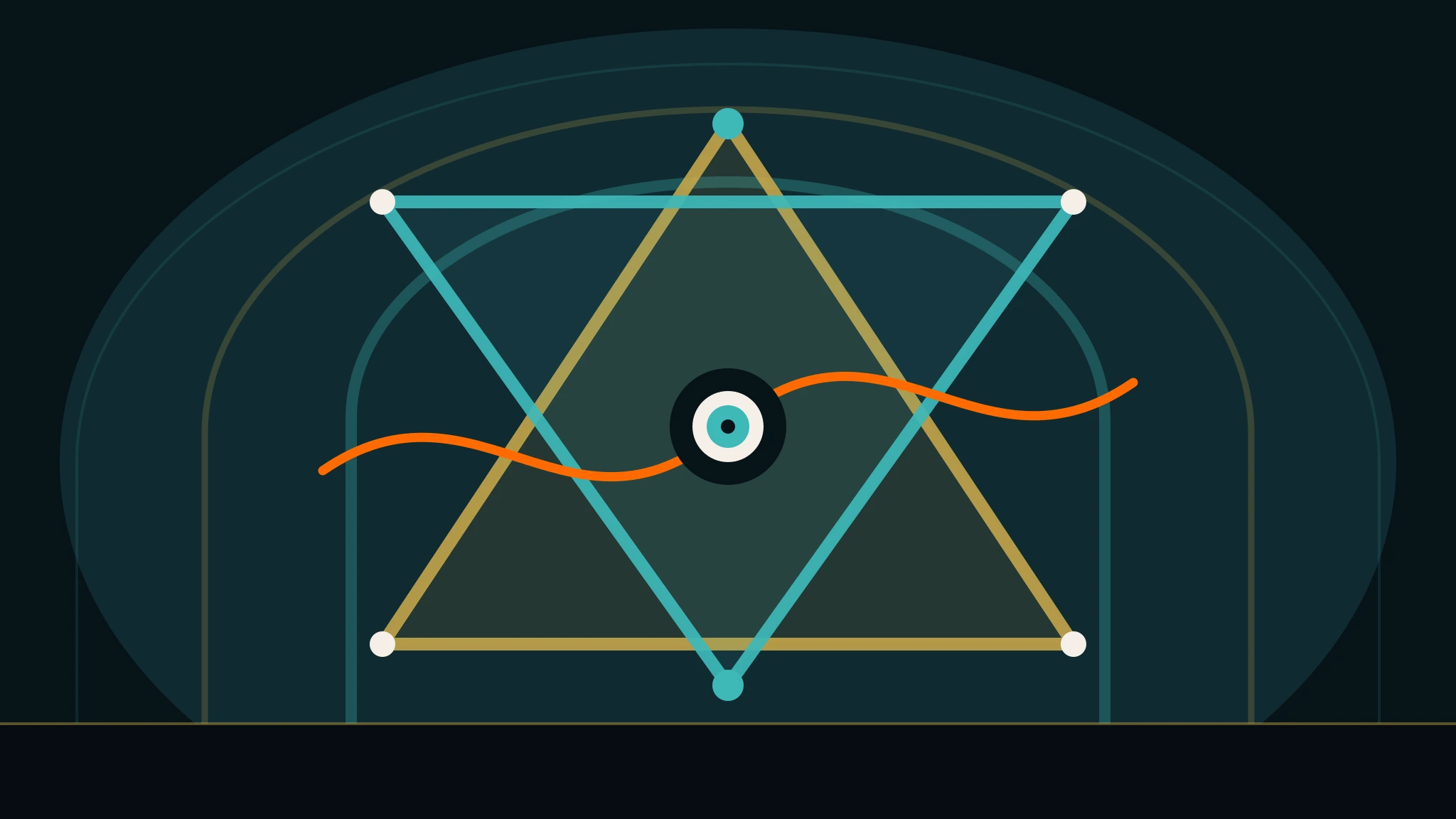
The image that carries this study stands above everything: two interpenetrating tetrahedra. The ascending triangle: fire, will, the masculine pole. The descending one: water, devotion, the feminine pole. Neither swallows the other; they interpenetrate and form a star. That is exactly what “the human being as a whole” means: not the dissolution of difference, but its union at eye level.
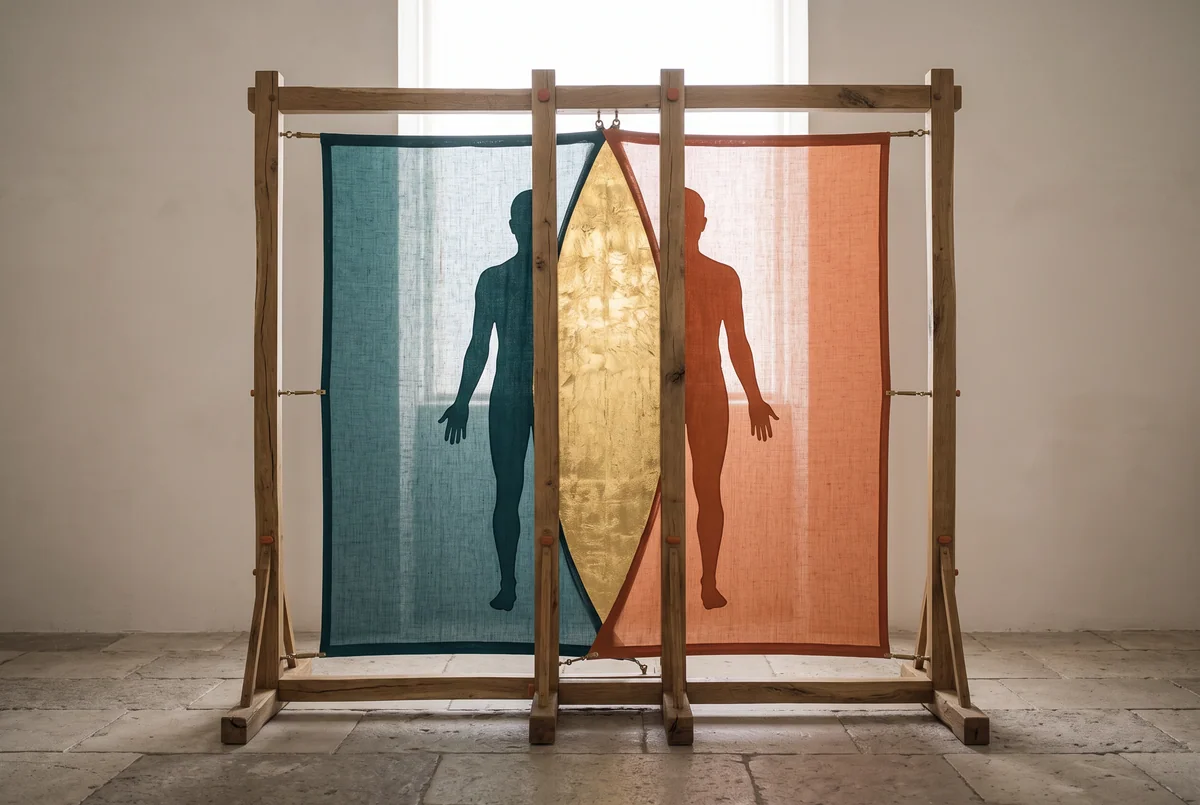
The masculine pole is wounded too: the ban on feeling, the enforced hardness, the loneliness. The fusion heals both: it gives woman back her strength and man back his heart.
Goethe's color wheel
For Goethe, every color arises from the play of light and darkness, the warm and the cool pole. Tap the wheel: at one end the two meet in green (union, life), at the other in the purple blend (intensification, spirit). The same movement as in the Merkaba.
Not the victory of one pole, but their wedding.

XIV · The Image of God
The united divine
What if the divine were not Father or Mother, but both in one? Many traditions have known this image, and then divided it.
Ardhanarishvara (Hindu): Shiva and Shakti in one body, the right half masculine, the left feminine: “the two principles are inseparable”. Rebis (alchemy): the wedding of sun and moon into one crowned double being. Adam Kadmon (Kabbalah): the primordial human before the division, masculine and feminine within each other. In the Gnostic Pleroma, Sophia (wisdom) and Logos are two sides of the same whole. And C. G. Jung calls the union of anima and animus the true goal: the whole Self.
Not halved, but interwoven
The old images often split the body into two halves. The united divine goes further: gold and silver are not separated, they interweave like a double helix. No pole gets just one side. Both permeate the whole.
Schalem, the whole one, he and she
A name from the orbit of this study: Schalem (Hebrew for “whole, intact, complete”), also an old name for twilight, the hour in which light and dark meet. An image of God as completeness, addressed not as “He” or “She” but as “You”.
At eye level, not on a throne
This divine looks at you from the same height. It dwells in the world (immanent) and surpasses it at the same time (transcendent): the sun in one hand, the moon in the other, the heart green with life, the crown purple.
Not Father in heaven, not Mother Earth alone: the twilight in which both are one.

XV · Spirituality without Hierarchy
Faith without a throne
What would a faith feel like that holds both poles in balance and gets by without domination? Not a pyramid with a mediator at the top, but a circle in which the sacred is equally close to everyone. Such paths already exist.
No throne, no elevated center. The glowing center belongs to everyone. The four directions (will, feeling, body, spirit) in balance.
Pyramid↔Circle
Access to the sacred
through a mediator
direct
Access to the sacred
immediate for everyone
Decision
command from above
consensus
Decision
sought in the circle
Role
fixed priestly caste
rotates
Role
service changes hands
Measure
dogma above experience
experience
Measure
one's own experience counts
The Quaker example
Without clergy since the 17th century: an “inner light” in every person, decisions made in silence and by consensus. They did not abolish the priesthood but the laity: everyone is a priest.
Both poles in the rite
Silence and receiving (the feminine pole) and word and deed (the masculine). The sacred dwells in the body, in the earth, in the cycle, not only in the beyond.
The circle of directions
Earth-rooted paths honor four forces equally: air/mind, fire/will, water/feeling, earth/body. None stands above another. Balance instead of ranking.
Festivals in the circle of time
Not only the straight line from creation to judgment, but also the returning wheel of the year: solstices, becoming and passing away as sacred.
How it feels: not awe before a throne, but belonging in a circle. Not fear of judgment, but trust. The sacred is at once utterly near (in the breath, in the body, in the encounter) and infinitely far. And no one stands between you and it.

XVI · Practice
Paths to fusion
The poles are not reconciled by thinking alone, but by practice. Nobody has to become “androgynous”. The point is to give the long-suppressed force in you room again, until both act together. Eight concrete paths. Go gently: balance is not a competitive sport.
01
Honor doing and being equally
Alongside the to-do lists, deliberately schedule times of doing nothing, and do not justify them. Rest is not a wage to be earned but a pole of its own.
02
Ask the body
Before deciding in your head alone, pause: what does the body report: tightness or spaciousness? That felt sense is information, not noise.
03
Practice receiving
Accept a compliment, a gift, help, without immediately giving something back. Being able to receive is the feminine pole, and for many, harder than giving.
04
Bring feeling to the table
In decisions, name the emotion alongside the arguments: “I think X, and I feel Y.” Both belong in the same equation.
05
Clear boundary, full devotion
Practice the unambiguous no (boundary, masculine pole) and the whole-hearted yes (devotion, feminine pole). Both take courage, and you are allowed both.
06
Cyclical, not only linear
Notice your rhythms of strength and retreat instead of demanding the same of yourself every day. The moon waxes and wanes, so do you.
07
Honor the opposite pole in the other
Where the other way irritates you (too emotional, too sober), practice seeing it as a missing half rather than a fault. That is how friction becomes complement.
08
Contemplation, not only analysis
Take a few minutes each day just to behold something (a plant, the sky) without dissecting it. Goethe's “Anschauung”: coming to know by lingering with love.
If a pole has been buried for a very long time, its reawakening can also stir grief or resistance. That is normal. In deep distress, a person you trust will accompany you better than any exercise.

XVII · Taking Stock
Humanity's greatest challenges
When one pole dominates the other for millennia, consequential damage follows, up to the question of survival itself. Here are the ten gravest, weighted by cost in lives, planetary reach and leverage (how much would change if balance were restored). A ranking meant as food for thought. Reasonable people would sort it differently.
Domination of nature & the ecological crisis
The same logic that subjugates the feminine subjugates the earth. Dominating the living without a counter-pole threatens the basis of life for the entire species, the largest scale, irreversible.
up to 2.4 billion people soon facing water scarcity
From dominating to stewarding: an economy of cycles instead of plunder.
Violence against women & femicide
The most brutal, most direct manifestation of the logic of ownership. For countless women, home is the most dangerous place.
137 killings per day · one every 10 minutes
Early intervention, law, and a new culture of the masculine.
The monopoly on decision-making
Whoever decides, decides on everything else on this list. As long as one pole dominates finance, foreign affairs and defense, half of humanity goes unheard.
27.2% women in parliaments · parity not before ~2063
Shared power: connection instead of ranking as the organizing principle.
The care collapse
The invisible foundation of every economy goes unacknowledged and threatens to break under an aging population.
$10.8T unpaid · 2.3 billion needing care by 2030
Make care visible, revalue it, share it fairly.
The gender health gap
Half of humanity is treated by a medicine calibrated to the male body, with misdiagnoses as the result.
<30% women in early clinical trials
Gender-sensitive research: the whole human being as the measure.
Algorithmic entrenchment
AI learns the imbalance from the data and scales it into every future decision: hiring, credit, diagnosis. The fastest-growing danger.
UNESCO 2024: pervasive bias in large models
Diverse data, transparent models, mixed teams.
Bodily sovereignty & reproductive self-determination
Control over the female body is contested in many parts of the world, the basis of all further freedom.
Self-determination as a non-negotiable foundation
Each person has authority over themselves. Everywhere.
Sexualization & digital violence
Beauty pressure, objectification and AI deepfakes turn bodies into images and merchandise, with deep consequences for self-worth and safety.
Deepfake abuse overwhelmingly targets women & girls
Give the body back as subject, online and offline alike.
Spiritual uprooting
Splitting off the connecting, the receiving, the sacred leaves behind a culture that can measure everything and no longer feels anything: a breeding ground for loss of meaning.
A crisis of meaning as collective exhaustion
The divine feminine as an equal path to meaning.
The wounded masculine pole
Patriarchy wounds its bearers too: the ban on emotion, the compulsion to be hard, the loneliness. The fusion is not man's defeat. It is his liberation.
Men seek help less often, with deadly consequences
Give man back his heart, and woman her strength.

XVIII · Living Deepening
The mirror of the poles
This study does not end with reading. Speak with it. The Mirror is a companion carried by a Mistral language model, hosted in the EU. It answers in the spirit of this page: nuanced, non-essentialist, honest. Ask about a concept or a field, or hold up your own inner conflict and let it be mirrored along the two poles.
The Mirror does not replace medical, legal or therapeutic advice. In emotional distress, please turn to a person you trust or to a professional service.

XIX · Evidence & Reading
Sources
Empirical findings are backed by current primary sources. The philosophical-spiritual strands are marked as traditions of thought: they are offered interpretations, not measurable facts.
- 01 · UNODC & UN Women: Femicides in 2024 (Nov 25, 2025), 50,000 femicides, 137 per day. unwomen.org ↗ · Empirical · UN
- 02 · Oxfam: Time to Care / Inequality Inc., $10.8T in unpaid care work, 12.5 billion hours/day, $105T wealth gap. oxfam.org ↗ · Empirical · NGO
- 03 · IPU & UN Women: Women in Politics 2025, 27.2% of MPs, 25 women heads of state or government, parity ~2063. ipu.org ↗ · Empirical · IPU
- 04 · German Federal Statistical Office: Gender Pay Gap 2025 (16%) & Labor Market Gender Gap (37%), Equal Pay Day Feb 27, 2026. destatis.de ↗ · Empirical · official
- 05 · UNESCO: Bias against women in LLMs (2024); UN Women & UNDP on AI bias, the “mom penalty”, deepfakes. unwomen.org ↗ · Empirical · UNESCO
- 06 · Pharmazeutische Zeitung (2026) & DocMorris magazine: gender data / health gap, trial shares, endometriosis, heart attack. pharmazeutische-zeitung.de ↗ · Empirical · trade press
- 07 · Caroline Criado Perez: Invisible Women (2019) · Vera Regitz-Zagrosek: Gendermedizin (2020). · Non-fiction
- 08 · J. W. v. Goethe: Theory of Colours (1810) · “polarity and intensification” · Faust II. · Tradition · phenomenology
- 09 · Iain McGilchrist: The Master and His Emissary (2009) · Antonio Damasio: Descartes' Error (1994). · Neuroscience
- 10 · C. G. Jung: Mysterium Coniunctionis (1955/56) · Erich Neumann: The Great Mother (1956). · Depth psychology
- 11 · Riane Eisler: The Chalice and the Blade (1987), dominator vs. partnership model. · Cultural theory
- 12 · Vandana Shiva & Carolyn Merchant: ecofeminism, The Death of Nature (1980). · Ecofeminism
- 13 · Marija Gimbutas: The Language of the Goddess (1989). Note: archaeologically contested. · Tradition · contested
- 14 · Rudolf Steiner: anthroposophy & the Sophia idea · Laozi: Daodejing (yin/yang). · Spiritual tradition
- 15 · Pew Research / Religion News / The Conversation: women's ordination & religious leadership, male-dominated offices (Catholic/Orthodox, SBC, LDS, Orthodox Judaism) vs. reform movements. theconversation.com ↗ · Sociology of religion
- 16 · Friends Journal / Religion Media Centre: Quakers: “inner light”, no clergy, circle and consensus model. friendsjournal.org ↗ · Egalitarian spirituality
- 17 · The united divine: Ardhanarishvara (Britannica) · Rebis (alchemy) · Adam Kadmon (Kabbalah/Zohar) · the Gnostic Pleroma (Sophia/Logos) · Jung, anima/animus. britannica.com ↗ · Tradition · symbolism