


energies · XIII / XX · Sphere C · Mind & Pattern · All 20
You have a map of yourself, and it is not the territory.
Describe yourself in three sentences. What you get is a map: as constructed as the periodic table, and just as useful. It's just that it has never been identical to what is actually there.
Do you know it, when someone describes you, and you think "that is not who I am"? You have a different map of yourself than they do. Both maps are partial. The question is not which is correct, but: which one serves the experience right now?
I · Structure · Measurable
Self-concept research (Markus & Wurf 1987 → Robins 2024): we hold multiple self-schemata in parallel, activated situationally. The working self-concept is not stable but fluid.
II · Flow · Tradition
Buddhist teaching of anattā (non-self): the fixed I is a construction. Hinduism: ātman as the observer behind the maps. Both traditions: recognise the map, then work with it without identifying as it.
III · Breadth · Synthesis
Mindfulness research (Vago & Silbersweig 2012, updated): experienced meditators show reduced DMN activity during self-reference: their map is lighter, because they do not mistake it for reality.
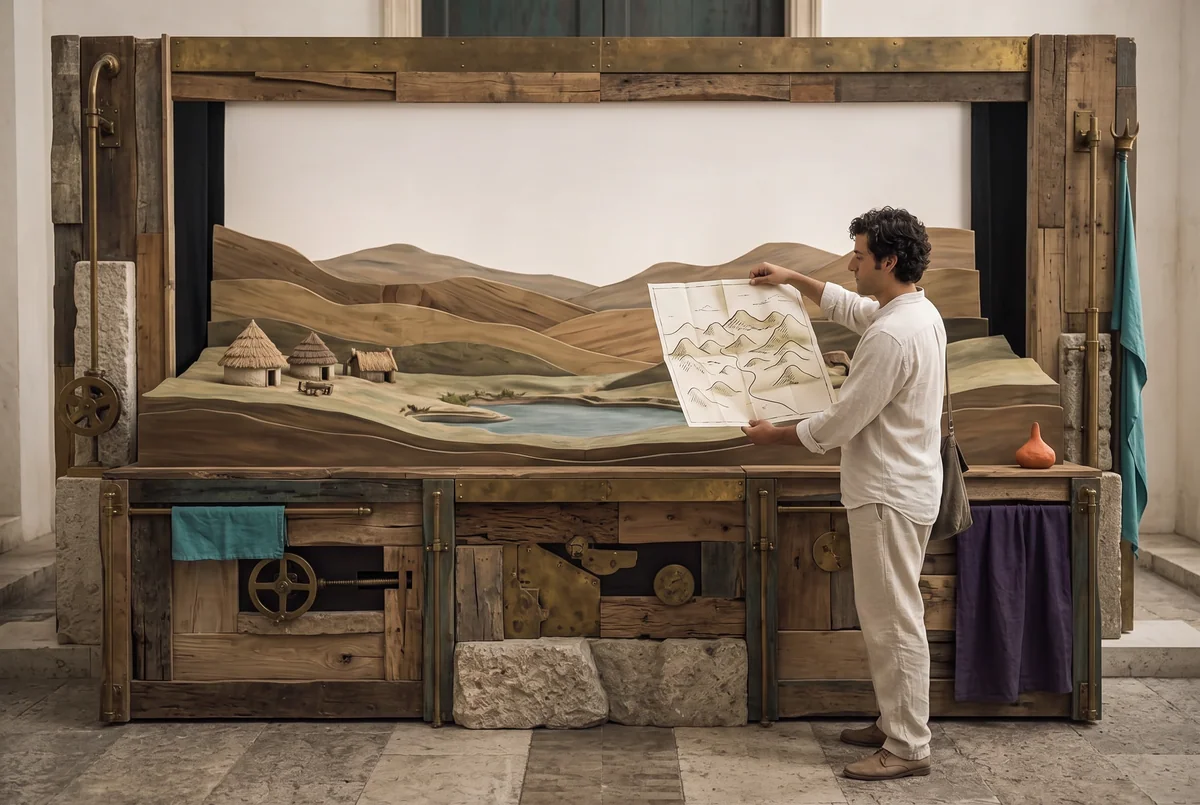
Map ≠ territory
Describe yourself in three sentences. Then read the first sentence again and ask: is that the map, or the territory?
Tool · Writing moment
local only · nothing is sent