



Project Enlightenment · Overview
Project Enlightenment · Part I · Segments 00–08
The Machine & the Counter-Voice
A history of humankind: how power structures harden, how fictions become weapons of entire groups, and why the lie survives the age of free knowledge.
The same capacity that lets us cooperate is the one that lets us be divided and ruled. That is the key to everything that follows.
Listen (read by Mira)
The Pendulum That Carries the Whole of History
The Fiction Machine
Power · Lies · Us-versus-Them
The Counter-Voice
Truth · Awareness · Compassion
History is the pendulum swing between the machine that entrenches power and the voice that exposes its mechanism.
00 · The Machine
Shared Fictions: the Only Superpower
Humanity’s superpower is not fire or tools, but the belief in things that do not physically exist: gods, money, nations, law, corporations. A chimpanzee will not give up bananas in this life for bananas in the next. We will.
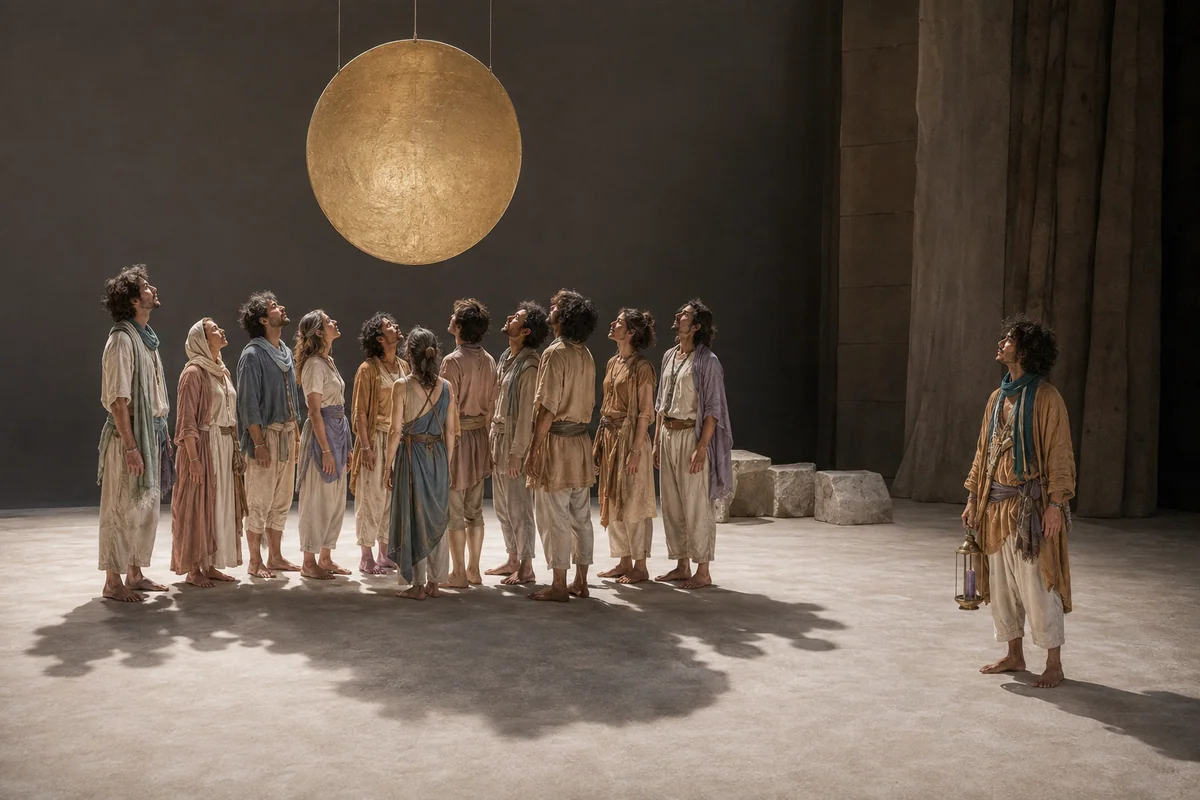
Crucial for everything that follows: a fiction is not the same as a lie. Money works because everyone believes. That is not fraud, it is a contract.
The “lie” only arises when a few steer a shared fiction so that it harms the many and benefits the few.
Power is nothing other than control over a group’s fiction.
01 · The Tribe
Why Division Is the Default State
Before any ruler invented “divide and rule”, humans were already divided. By nature. Over hundreds of thousands of years our brain was shaped in small groups: trust inward, distrust outward. We think in Us and Them. That is not a moral weakness but a survival program: coalitional psychology, the Dunbar number of roughly 150 trusted relationships.
The tricks of power were not invented. They were discovered.
No one had to create hatred of the stranger. One only had to learn which button to press. Everything that came later is a refinement of this single lever.
02 · The Surplus
The Birth of Hierarchy and the First Sacred Lie
With agriculture (~10,000 BCE) comes surplus. Surplus must be stored, guarded and distributed, and whoever does that holds power. Now a problem arises that every surplus society solves independently: legitimacy. Why does the king get to eat first?
The answer converges everywhere on the same solution: the ruler is divine or chosen by God: pharaoh, Sun King, Son of Heaven, the divine right of kings. This is the first fiction turned into a weapon: an inequality created purely by force is reinterpreted as cosmic order.
Not “I have the spears”, but “the gods will it so”.
Here, for the first time, the lie becomes the architecture of power. Not a coincidence, but the inevitable answer to the problem of legitimacy.
03 · Writing
The Technology of Control
Writing emerges (~3500 BCE) first for tax records, not for poems. Its power: a fiction now outlives its teller and can be copied. Law, debt and myth become fixed and standardized.
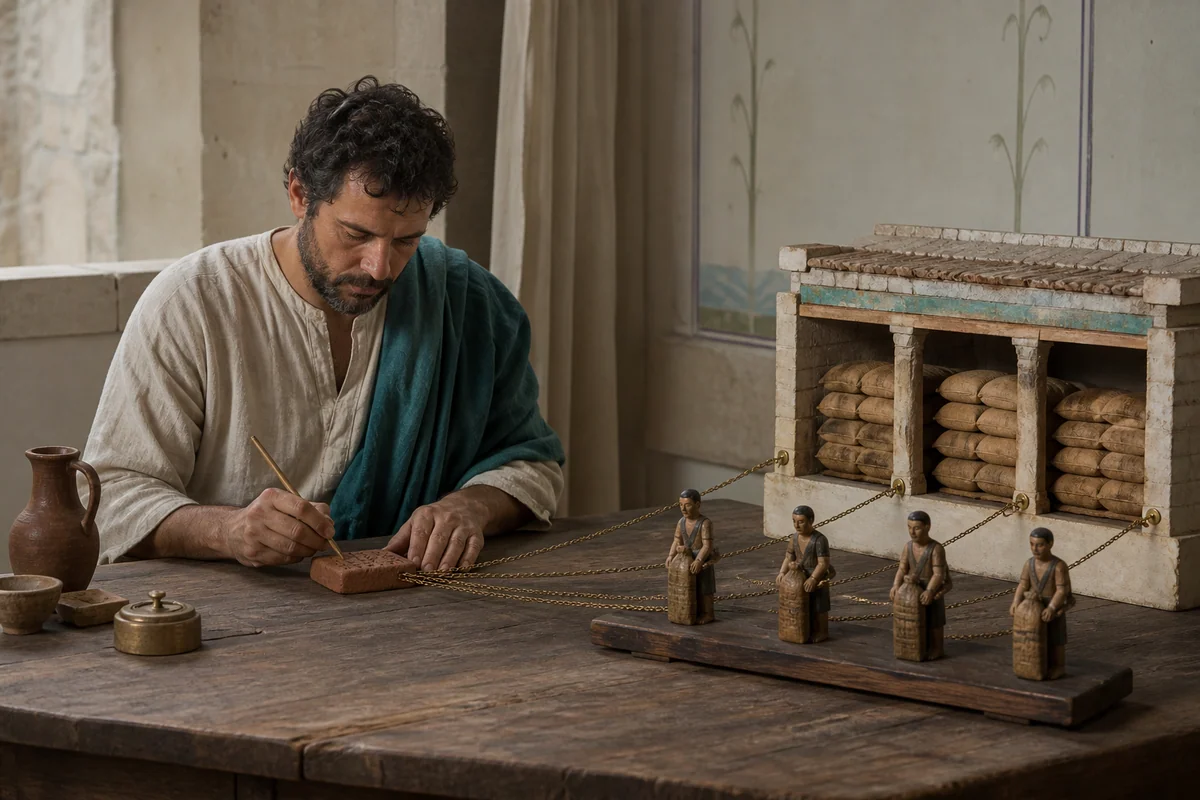
The first information-monopoly class is born: priests and scribes, the only ones able to read, who thereby control what counts as true. Whoever controls the text controls the reality of the illiterate.
The pattern is born: whoever controls the narrative controls the people.
04 · The Empires
“Divide et impera” Becomes a Method
How do you rule millions of strangers? With a universal fiction: the imperial cult, universal law, later world religion. Persia, Rome, Han China and the Maurya all solve the same scaling problem.
And here the catchphrase literally becomes administrative practice: “divide and rule” is Roman. You keep the conquered weak by setting them against each other (tribe against tribe, nobility against commoners) so they never unite against the ruler.
Not a conspiracy theory. Documented statecraft.
The innate Us/Them reflex from Segment 01 is deliberately loaded and aimed at targets other than the true source of power.
05 · The Counter-Voices
Buddha, Jesus, Gandhi: the Species’ Immune Response
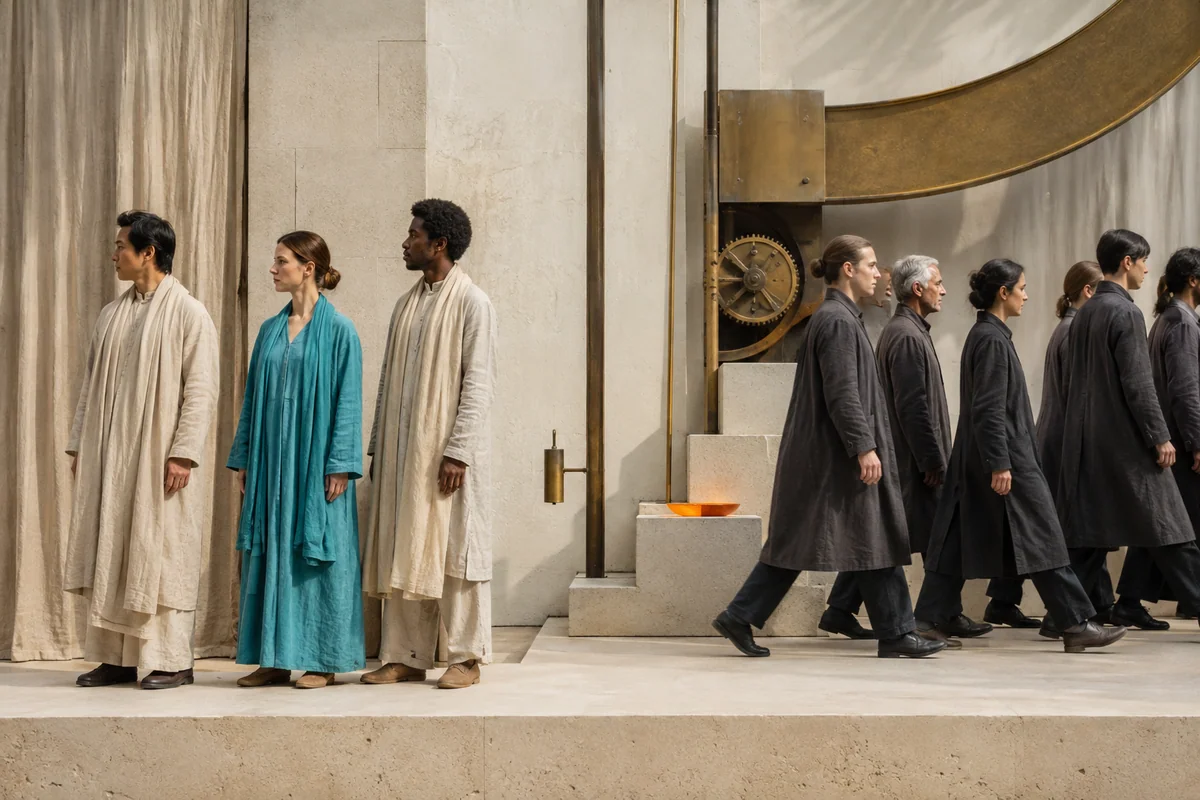
In the Axial Age (~800–200 BCE) a new type of human appears: not builders of power, but questioners of it. They attack not one ruler, but the machine itself.
Buddha
Self, greed, us-versus-them: all illusion. He attacks the fuel: the clinging ego from which hierarchy and hatred arise in the first place.
Jesus
“Love your enemy” erases the enemy image, the core of every divide-and-rule logic. “The kingdom is within you” strips every earthly power of its cosmic legitimacy.
Laozi & the Prophets
The Daoist “non-forcing” and Israel’s socially critical prophets place justice above ritual and rule.
Gandhi & MLK
Satyagraha literally means “truth-force”: the deliberate weapon of truth against the lie of power.
But here comes the tragic loop: the machine devours its critics. The man who attacked the temple becomes a church with its own hierarchy. Buddha wanted no statues. Thousands were built for him. “Love your enemy” turns into crusades.
Again no coincidence: every movement needs organization. Organization breeds hierarchy. Hierarchy needs legitimacy.
And so the counter-voice circles back to Segment 02 and becomes a power-fiction itself. That is why religion often feels like the opposite of what its founder said.
06 · The Industry of the Lie
How Deception Became a Science
In the modern era the technique changes, not the principle. The printing press democratizes fiction. And invents mass propaganda. The nation becomes the new god: millions who will never meet die for one another (“imagined communities”).
In the 20th century the age-old tricks become science:
Le Bon · crowd psychologyBernays · “engineering of consent”Lippmann · manufacture of consentGramsci · hegemonyFoucault · power produces truth
Gramsci shows: the ruled obey not because they are coerced, but because they have internalized the rulers’ worldview as “common sense”. Foucault sharpens the point: power does not merely suppress truth, it produces it.
Thus lying becomes the narrative of power: sacred myth → national ideology → industrially manufactured consent.
The nuance that guards against paranoia: the most effective lies are the ones the liar believes himself. Rarely a secret council of evil men, mostly people who mistake their ideology for the truth. The system is largely emergent, not centrally planned. That makes it both more benign (no omniscient enemy) and more dangerous (no head to cut off).
07 · Free Knowledge
Why the Lie Survives the Information Age
The core question: why do we stay divided and deceived when all knowledge is freely available? Because the bottleneck was never access to facts. It was always the human tendency to put belonging above truth. And that tendency is now, for the first time, being exploited automatically.
1. Information ≠ understanding ≠ wisdom. When information is infinite, attention becomes the scarce resource, and thus the battlefield.
2. We don’t seek truth, we seek tribe. “Identity-protective cognition”: facts become weapons for one’s own side. Smarter people are often better at lying to themselves.
3. The architecture selects for division. Platforms make money on time-on-site; outrage maximizes time-on-site. The tribal button from Segment 01 is pressed billions of times a day by algorithms that don’t want division. They want ad revenue.
4. The cost of lying has collapsed. Disinformation is free too: refuting a lie costs many times more than creating it (Brandolini’s law).
Divide and rule no longer needs a ruler. It runs decentralized, through the incentive structure itself.
In short: we do not live in the age of free knowledge, but in the age of free information amid unprecedented techniques of manipulation.
08 · The Way Out
The Counter-Voice Today
Across the entire arc, the antidote was always the same gesture: step out of the Us/Them game, refuse the enemy image, put truth above belonging.
What Buddha called “awakening”, Jesus “loving your enemy”, Gandhi “truth-force”, is, in modern vocabulary, simply this: metacognition, epistemic humility, deliberately seeking out the strongest counter-argument, and noticing the moment you are being recruited into a tribe.
The division does not sit out there in the system. It sits in the very brain region that makes us capable of community in the first place.
That is why the way out was never better information, but a different awareness. The age of free knowledge could be the first in which this counter-voice scales. But only if the individual does the inner work that all the sages have always pointed to.
The Synthesis in One Sentence
History is the pendulum between the machine, which entrenches power by playing on the innate tribal reflex, and the counter-voice, which exposes that mechanism. The lie survives not because of a hidden puppet-master, but because it rides on a real, useful feature of our mind. Only those who recognize this feature in themselves break the loop.
✦ · Sources
Sources & Trails for Further Thought
One entry point per building block of the narrative: the books, terms and concepts it rests on. BOOK = work · TERM = key term · CONCEPT = theory/model.
The Machine & the Tribe: Where Division Comes From
- Book · Yuval N. Harari: Sapiens: Shared fictions as the foundation of large-scale societies. ↗
- Concept · Dunbar’s number: ~150: the natural ceiling for stable relationships of trust. ↗
- Concept · In-group / Out-group: The Us/Them psychology: coalitional thinking as a survival program. ↗
- Term · Confirmation bias: Why we seek facts that prove us right. ↗
Power, Legitimacy & Divide-and-Rule
- Term · Divine right of kings: The first fiction turned into a weapon: rule as cosmic order. ↗
- Term · Divide et impera: “Divide and rule” as documented statecraft. ↗
- Book · Benedict Anderson: Imagined Communities: The nation as an “imagined community”. ↗
- Concept · Gramsci: Cultural Hegemony: Rule as internalized “common sense”. ↗
- Concept · Foucault: Power/Knowledge: Power produces what counts as “true”. ↗
The Industry of Consent
- Book · Gustave Le Bon: The Crowd: The first anatomy of crowd behavior (1895). ↗
- Book · Edward Bernays: Propaganda: Freud’s nephew invents PR: the “engineering of consent” (1928). ↗
- Book · Walter Lippmann: Public Opinion: Coins the phrase “manufacture of consent” (1922). ↗
- Book · Herman & Chomsky: Manufacturing Consent: The propaganda model of the mass media (1988). ↗
The Counter-Voices: the Axial Age & After
- Concept · Axial Age: Karl Jaspers’ thesis of a simultaneous spiritual turn. ↗
- Term · Buddha: The Four Noble Truths: Greed and ego-attachment as the root of suffering. ↗
- Term · Jesus: The Sermon on the Mount: “Love your enemy”: the dissolution of the enemy image. ↗
- Term · Gandhi: Satyagraha: “Truth-force” as a weapon against the lie of power. ↗
The Digital Age: Why the Lie Remains
- Concept · Attention economy: When information is infinite, attention becomes the battlefield. ↗
- Concept · Dan Kahan: Identity-Protective Cognition: Even the smartest use their intellect to defend the tribe. ↗
- Term · Brandolini’s law: Refuting a lie costs many times more than creating it. ↗
- Term · Filter bubble & echo chamber: How algorithms automate the Us/Them reflex. ↗
- Book · Shoshana Zuboff: Surveillance Capitalism: Behavior as raw material: the incentive behind the division. ↗